
How to measure AI readiness
Measure AI readiness on four dimensions: data, automation, adoption, and governance. Score them before you buy a platform or staff a council.
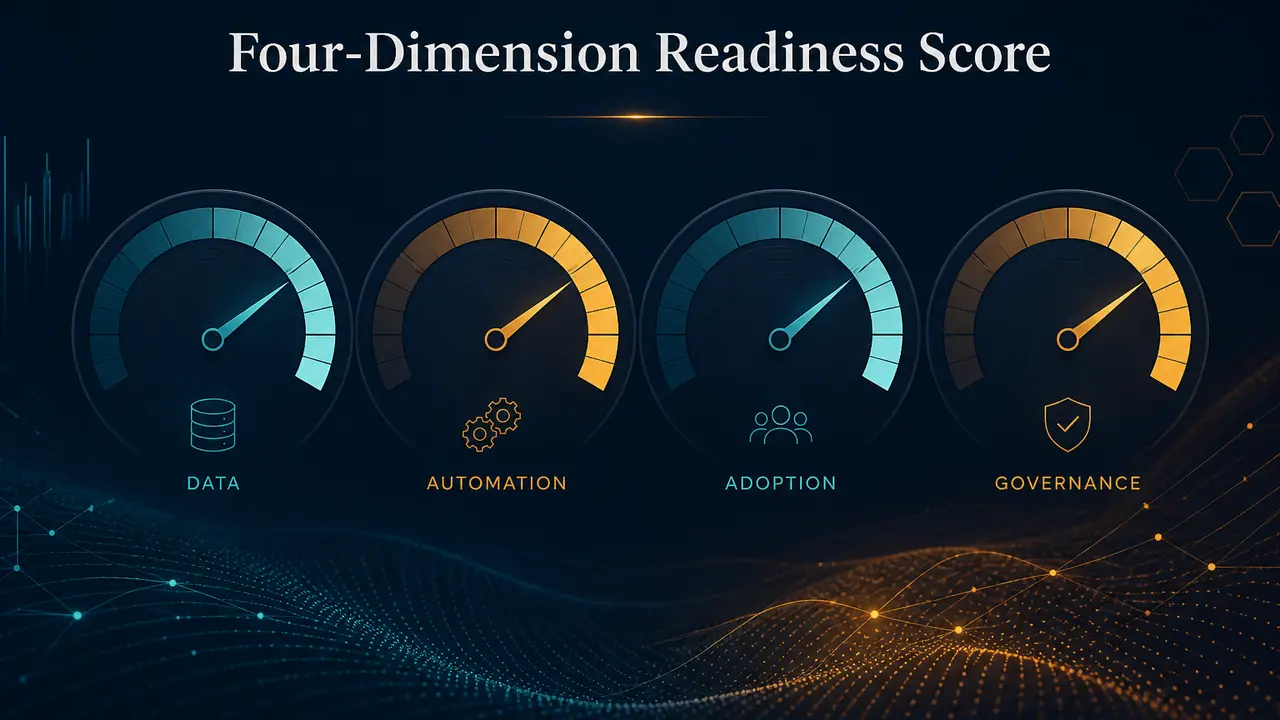
You do not measure readiness with a vendor scorecard or a 90-question RFP. You measure whether one real workflow can go live without leaking data, without a mystery owner, and without a model you cannot explain. Four dimensions are enough: data, automation, adoption, and governance.
That is what the 3-minute AI Readiness Assessment scores. Use the same four even if you never take the quiz. If you add a fifth "innovation culture" bucket, you are back to theater.
1. Data: can the first workflow see what it is allowed to see
Ask where the records live for the process you would automate first. One system of record is ready. Five exports and a "final_final" spreadsheet is not.
Ask who may see those records today. If you cannot map permissions, the model will either be blind or over-privileged. Both fail.
Ask whether you can tell a stale document from the live rule. If the policy PDF and the ticket queue disagree, retrieval will lie.
A useful data score is not "we have a lake." It is "for this workflow, we know the source, the owner, and the access list."
2. Automation: is there a painful step with a number
Readiness is not "we love automation." It is a named step that happens often, costs hours or errors, and already lives in your systems.
Write the baseline before you score yourself generous. Cycle time, touches, failure rate. If you cannot write the baseline, you are not ready to automate. You are ready to tour.
If the only candidate is a company-wide assistant, you do not have an automation score. You have a slogan. Pick claims intake, contract review, a weekly report, or another desk job.
3. Adoption: will a named person use the output
The user of the output has to exist before the model does. A sponsor in the steering committee is not a user. The adjuster, paralegal, or scheduler is.
Ask what they will do when the model is wrong. If the answer is "we have not thought about that," adoption is not ready. Put a human in the loop on purpose.
Shadow use of public chats is not adoption. It is a signal that official tools are too slow or missing. Count it as a governance and adoption gap, not as a win.
4. Governance: can you say yes or no this week
Ready governance is a short list of approved tools, a short list of data that never leaves the tenancy, and a person who can approve a low-risk use in days. It is not a 40-page policy nobody reads.
If employees are already pasting customer data into public models, your governance score is low no matter how many posters you printed. Governance as a gateway and an inventory is the mature form. For readiness, you only need the first rules and the first owner.
If legal and security have not seen how retrieval gets files, do not call yourself ready on this dimension.
How to turn the four scores into a decision
Score each dimension 0 to 25, or low / medium / high. The lowest score is the constraint. Do not average your way into a green dashboard.
If data is the floor, the next spend is access and a system of record, not a model. If automation is the floor, pick a smaller workflow. If adoption is the floor, find the user before you buy licenses. If governance is the floor, write the allow-and-deny list this week.
The free assessment gives you a 0 to 100 across those four, then a 30-minute walkthrough with your answers in hand. A Deep-Dive is only the next step if you want someone in your systems for two to four weeks. Do not invent a second quiz.
What not to measure in the first pass
Do not measure model brand preference. Do not measure how many employees completed an AI lunch-and-learn. Do not measure maturity level on a pyramid. Do not measure "digital excellence." Those numbers do not tell you whether Tuesday's workflow can ship.
Measure again after the first workflow is live or dead. Readiness is a gate. Once you are through it, switch to the readiness vs maturity distinction and start counting whether the second workflow is cheaper.
Take the 3-minute AI Readiness Assessment if you want the four-dimension score before the next vendor meeting.
