
MCP Servers
Every AI tool wants access to your systems. On its own terms.
Copilots, agents, and assistants each demand their own integration — custom connectors, duplicated logic, and credentials scattered across vendors. MCP replaces that N×M mess with one standard. But the standard doesn't ship with your security model: an ungoverned MCP server is a superuser API into your business.
What is an MCP server?
An MCP server exposes a system — your CRM, database, ticketing, or internal APIs — to AI assistants and agents through the Model Context Protocol, an open standard often described as USB-C for AI. Instead of custom integrations per tool and per model, you build one governed MCP server per system, and every AI client can use it. Mufasa Labs designs, builds, and secures MCP servers for enterprise environments.
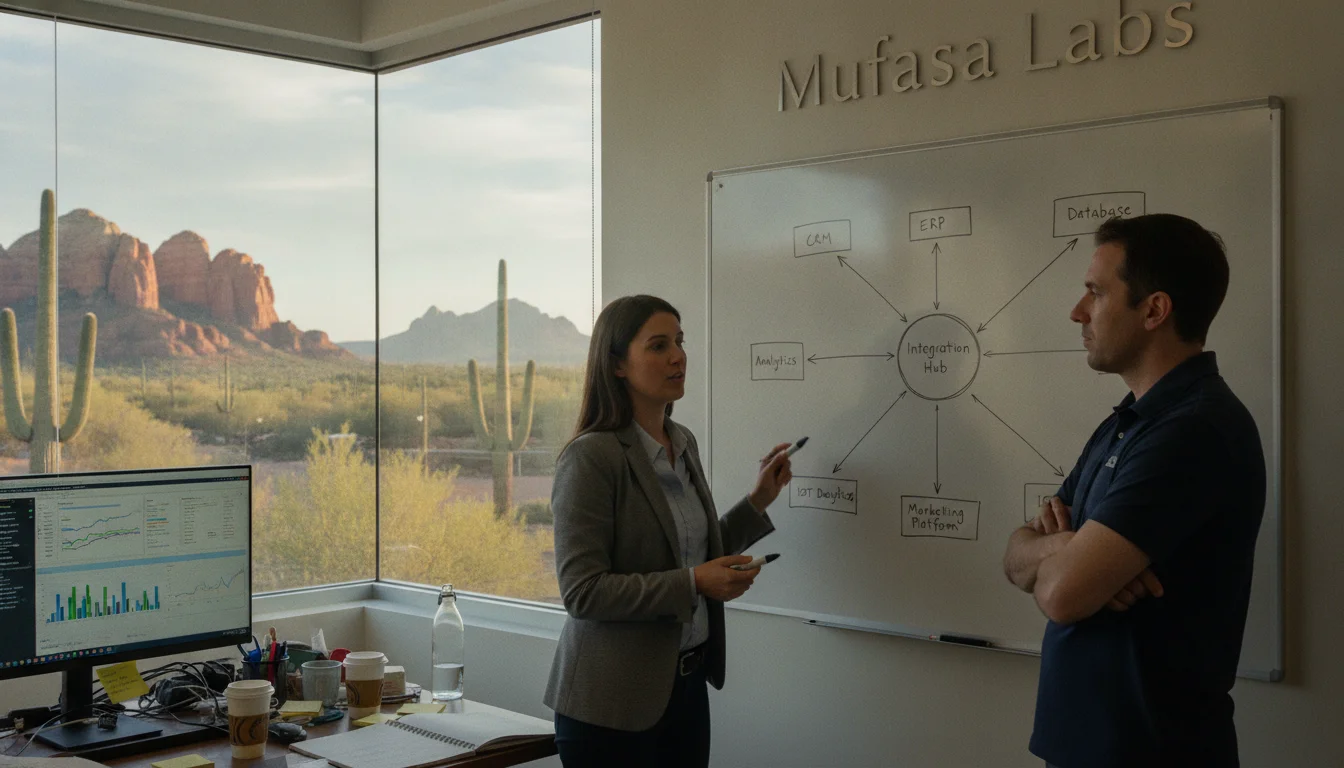
Who it helps
Built for the people carrying the load
Platform & integration teams
Build each system's AI interface once, instead of once per copilot, agent, and vendor.
CIOs & CISOs
AI access to internal systems through one governed, auditable front door — not five vendors' side doors.
Product teams shipping AI
Give your agents and assistants reliable tools with permissions and audit built in from the start.
In practice
One protocol between your AI and everything it needs to touch.
Copilots, agents, and assistants each demand their own integration — custom connectors, duplicated logic, and credentials scattered across vendors. MCP replaces that N×M mess with one standard. But the standard doesn't ship with your security model: an ungoverned MCP server is a superuser API into your business.
What we build
Everything the system needs to hold up in production
Custom MCP servers
Production-grade servers over your systems of record — CRM, ERP, databases, ticketing, internal APIs — with typed tools and sensible scopes.
Authentication & authorization
OAuth and identity-provider integration so every AI request acts as a real user with their real permissions — never a shared superuser key.
MCP gateway & registry
A governed catalog of approved servers with rate limits, request logging, and central kill-switches — who can use what, visible in one place.
Evaluation & hardening
Tool-level tests, prompt-injection defenses, and least-privilege scopes — validated before any agent gets the keys.
How it works
From kickoff to measured outcome
- 01
Map the surface
Which systems should AI reach, which operations are read vs. write, and what the permission model must enforce.
- 02
Build the first server
One high-value system gets a production MCP server with auth, scopes, and logging — typically live in weeks.
- 03
Stand up the registry
The gateway and approved-server catalog turn one-off integrations into a governed platform.
- 04
Scale & harden
More systems join the registry; injection testing, rate limits, and audits keep pace as agent usage grows.
How MCP works
The Model Context Protocol, in plain terms
Three roles and three primitives — that's the whole mental model.
Hosts, clients, and servers
The host is the AI application (Claude, a copilot, your agent). It runs a client that speaks MCP. Servers sit in front of your systems and answer. One client can use many servers; one server can serve many clients.
Tools — actions AI can take
A server exposes typed tools: look up a customer, create a ticket, run a query. The AI sees each tool's name, inputs, and description — and can only do what the server explicitly offers.
Resources & prompts — context AI can read
Beyond actions, servers can expose documents, records, and reusable prompt templates — so assistants ground their answers in live company data instead of stale copies.
Why a standard beats custom connectors
Without MCP, five AI tools times ten systems means fifty integrations. With it: ten servers, reused everywhere — and swapping AI vendors stops meaning rebuilding your integration layer.
Where servers run
In your cloud, next to the systems they front — deployed with the same Terraform, CI/CD, and monitoring discipline as any production service we ship.
What the standard doesn't give you
MCP defines how AI talks to tools — not who may call them, with what data, under whose audit. That's the enterprise layer below, and it's where most DIY deployments go wrong.
The enterprise layer
Five controls before an agent gets the keys
An MCP server without these is a superuser API with a friendly name.
Identity on every request
Servers integrate with your identity provider so each AI request carries a real user's identity — and their actual permissions decide what the tool returns.
Least-privilege tool scopes
Read tools and write tools are separated, destructive operations require approval gates, and each agent gets only the tools its job needs — nothing more.
Central gateway & registry
All MCP traffic flows through one governed gateway: an approved-server catalog, rate limits, anomaly alerts, and a kill-switch per server or per client.
Audit trails that answer questions
Every tool call is logged with who, what, and why — the record your security team needs when something looks odd and your auditors ask how AI touches data.
Injection & abuse testing
Tool descriptions and outputs are attack surfaces. We test servers against prompt-injection and data-exfiltration patterns before agents rely on them — and re-test on every change.
Outcomes
What good looks like
Why teams trust us
No leap-of-faith moments
- We build on the open MCP standard — no proprietary protocol that locks your integrations to us.
- Every server enforces your identity provider's permissions; agents act as users, never as superusers.
- Servers land in your repos with tests and docs — maintainable by your team, like everything we ship.
FAQ
MCP Servers: common questions
What is MCP (Model Context Protocol)?
MCP is an open standard that lets AI applications connect to external systems — data sources, tools, and APIs — through one common protocol. It's often described as USB-C for AI: instead of a custom integration per AI tool per system, you build one MCP server per system and every compliant AI client can use it.
Why should enterprises care about MCP now?
Because AI assistants and agents are only useful when they can reach your systems, and the integration question is being answered right now — either deliberately, through a governed MCP layer, or accidentally, through scattered vendor connectors and shared credentials. The standard has broad industry adoption across major AI platforms, so it's the safe architectural bet.
Are MCP servers secure enough for enterprise data?
The protocol is sound; the risk is in deployment. A server exposed without authentication, permission checks, and audit logging is a superuser API into your business. Built properly — identity on every request, least-privilege scopes, a gateway, and injection testing — MCP is more governable than the pile of one-off connectors it replaces.
How is MCP different from a regular API?
An API is built for developers who read documentation; an MCP server is built for AI models that read tool descriptions. MCP standardizes discovery, typed inputs, and context exchange so any compliant assistant can understand and use your systems without custom glue code per model.
Which of our systems can be exposed through MCP servers?
Nearly anything with an interface: CRMs, ERPs, databases, ticketing, document stores, and internal APIs. The real question is which systems your AI use cases need — we start from the workflows, map the minimal tool surface, and build servers for those systems first.
Can you secure MCP servers our team already built?
Yes — hardening existing servers is common work: adding identity-provider auth, splitting over-broad tools into least-privilege scopes, wiring in logging, and putting the server behind the gateway and registry. The audit usually takes days and produces a fixed-scope plan.

How to start
Book a 30-minute scoping call. You'll leave with an honest read on feasibility, a rough timeline, and a fixed-scope path to a pilot — whether or not you hire us.