
Blog
Notes from the field.
What actually works in enterprise AI — implementation patterns, industry playbooks, and honest takes on the hype cycle.
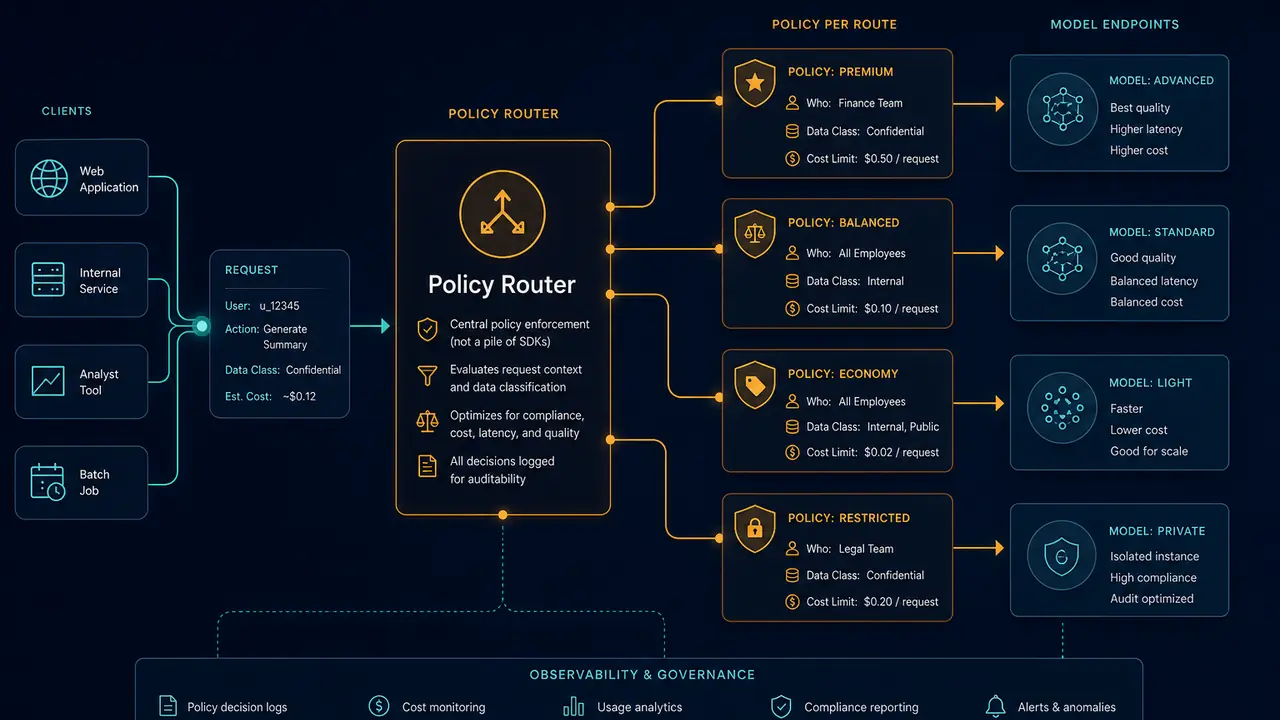
Multi-model AI architecture
Multi-model architecture is a router with policy, not a pile of SDKs. Pin who may call which model, for which class, at what cost.
Read more →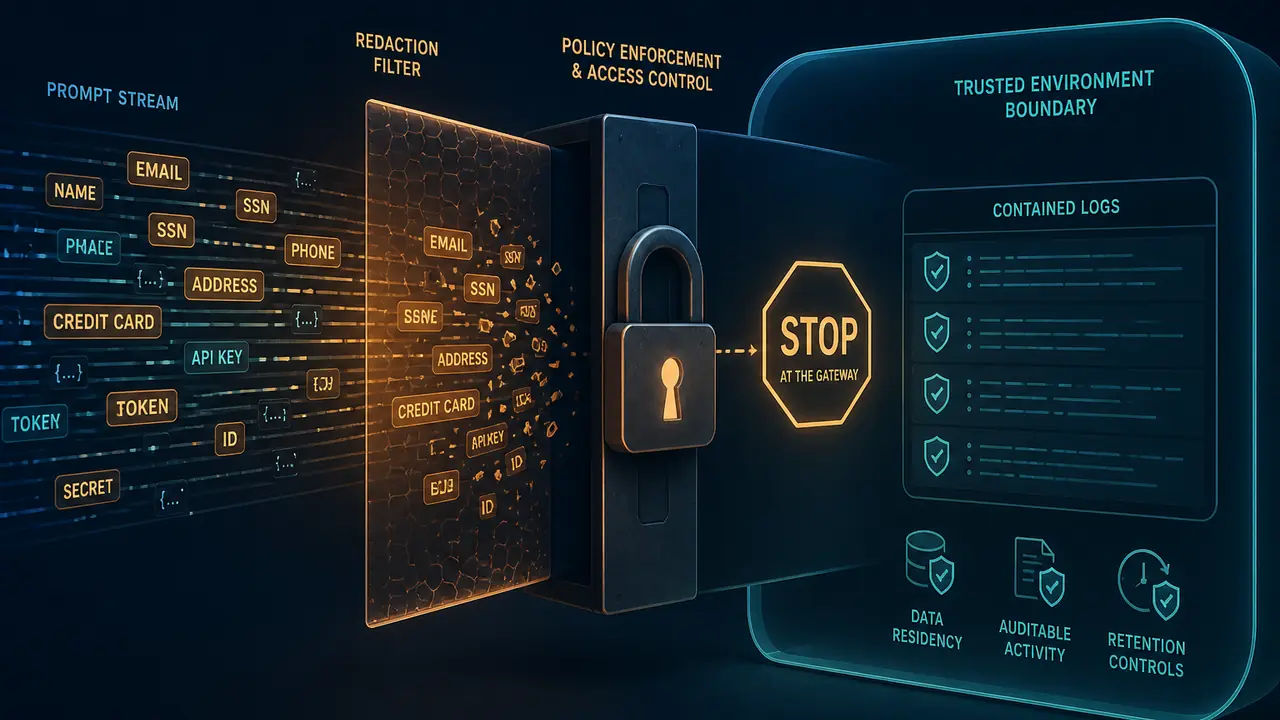
AI prompt and data leakage prevention
Prompt leakage is data leaving through the model hop: pasted secrets, unredacted PII, and logs that outlive the ticket. Stop it at the gateway, not in a policy PDF.
Read more →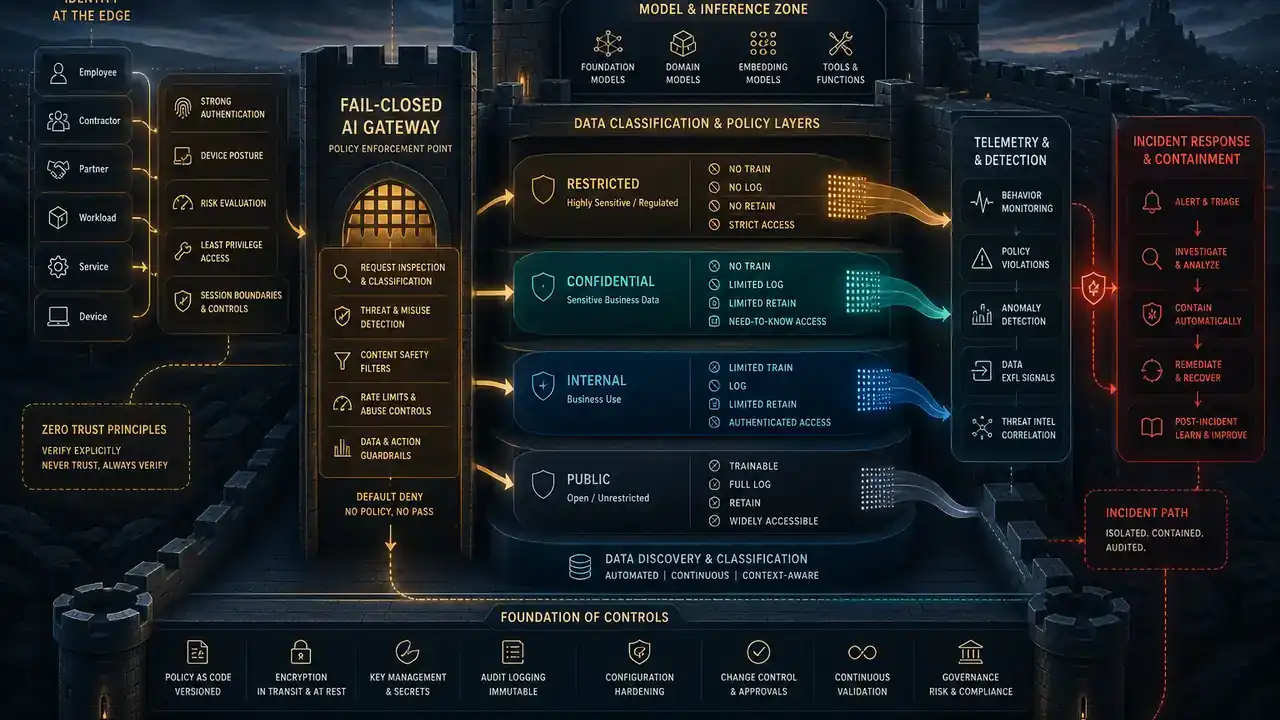
Enterprise AI security architecture
Enterprise AI security architecture is identity, a fail-closed gateway, data-class policy, and an incident path. A model vendor's SOC report does not replace yours.
Read more →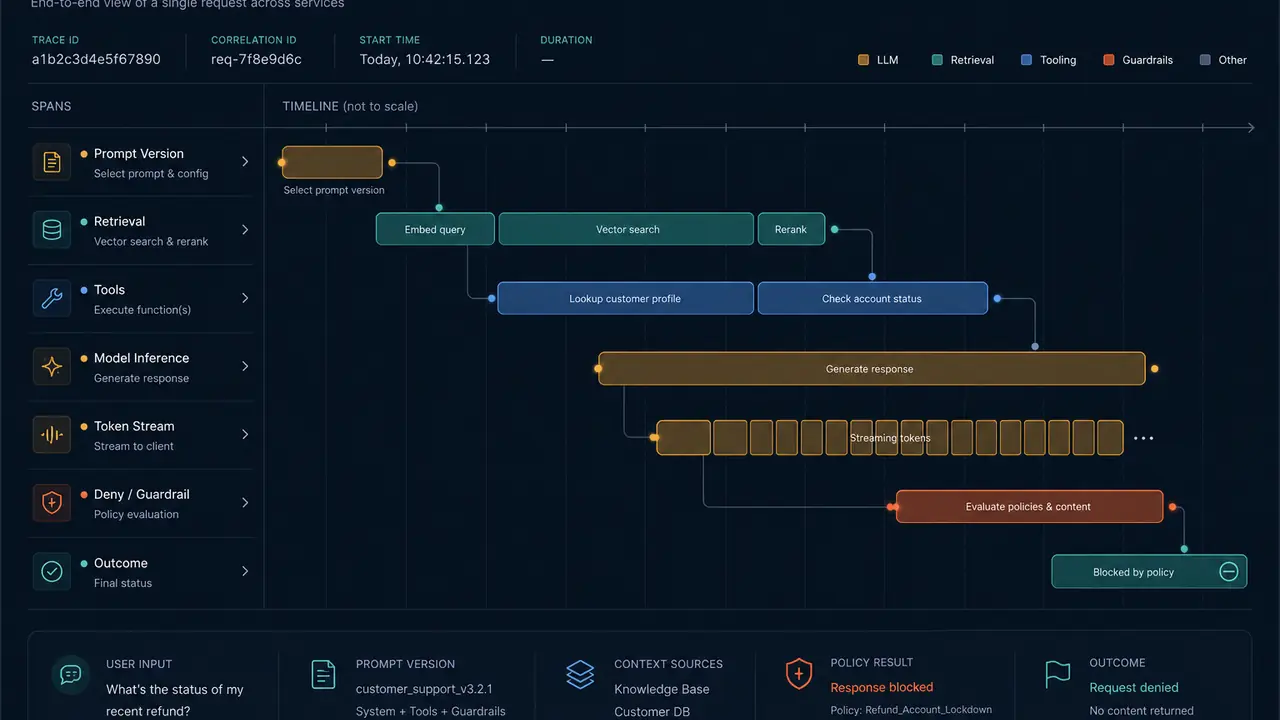
AI observability
AI observability is request-level traces: prompt version, retrieval, tools, tokens, denies, and outcomes. A vendor usage graph is not observability.
Read more →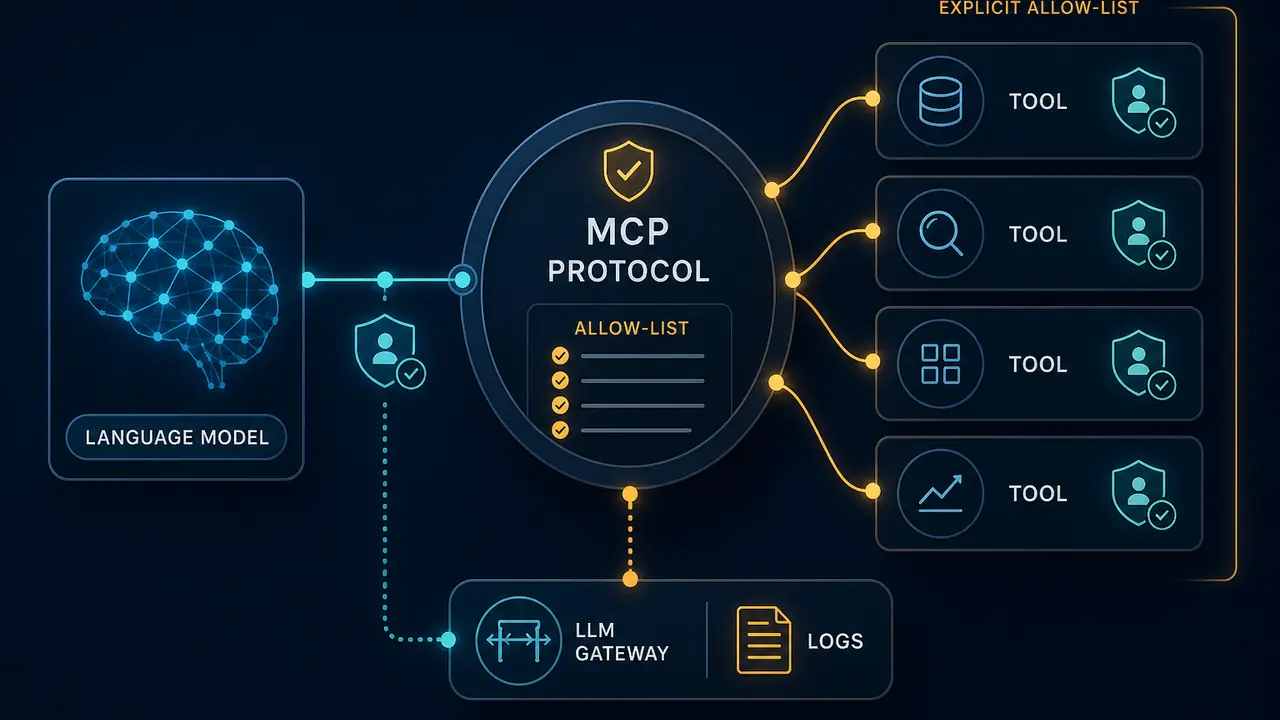
MCP architecture
MCP architecture is how tools are exposed to models: one protocol, explicit allow lists, identity on every call, logs on the same hop as the LLM gateway. A pile of ad-hoc function calls is not an architecture.
Read more →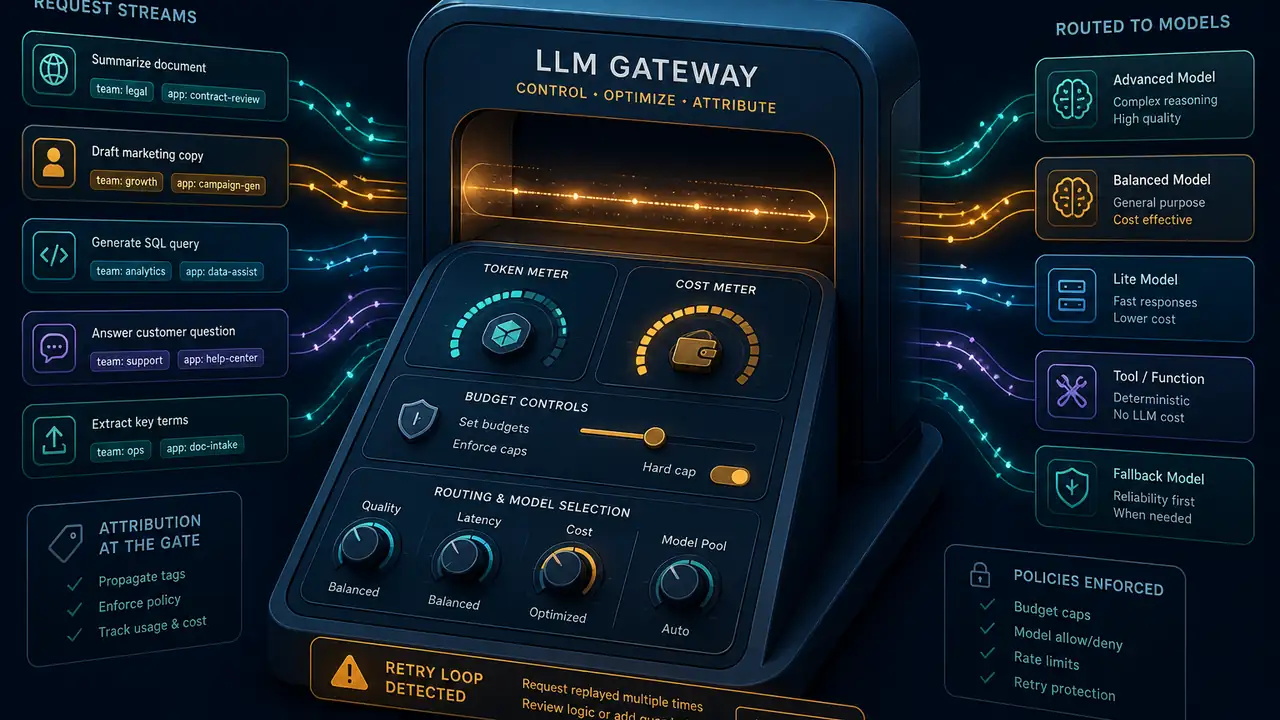
LLM cost management
LLM cost management is attribution, caps, and routing on a gateway — not a spreadsheet after the invoice. Token spend is not labor ROI. Treat a retry loop as an ops event.
Read more →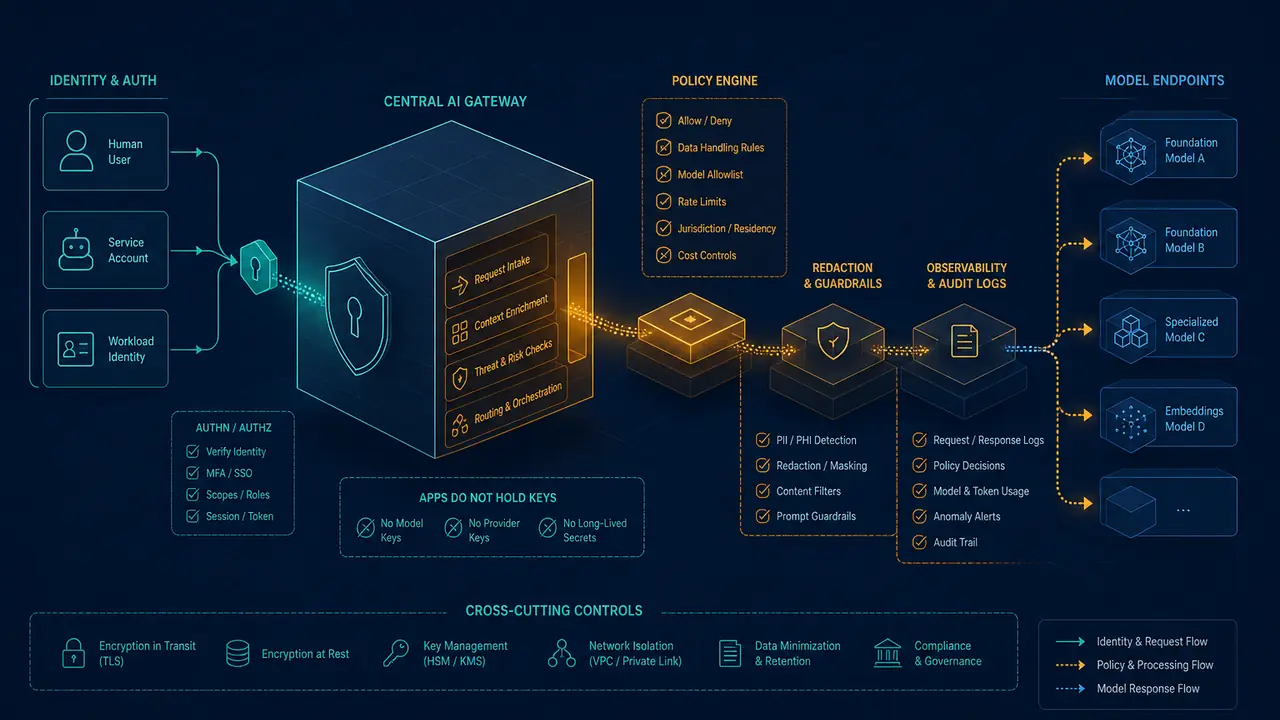
Enterprise LLM gateway architecture
An enterprise LLM gateway sits in your environment: identity in, policy on the request, logs and redaction on the hop, models out. Apps should not own vendor keys.
Read more →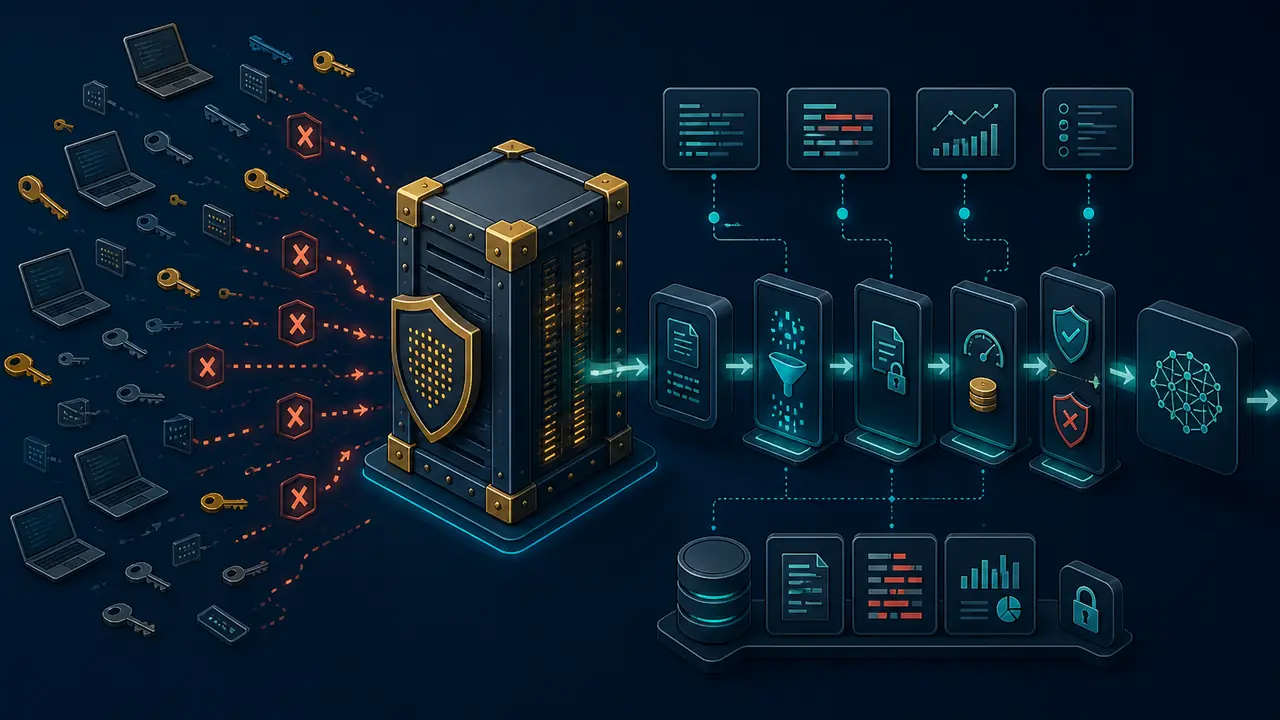
Why enterprises need an LLM gateway
An LLM gateway is the one path for model calls: logging, redaction, cost limits, and allow/deny on the request. Without it you have keys in laptops and a policy PDF that cannot see a prompt.
Read more →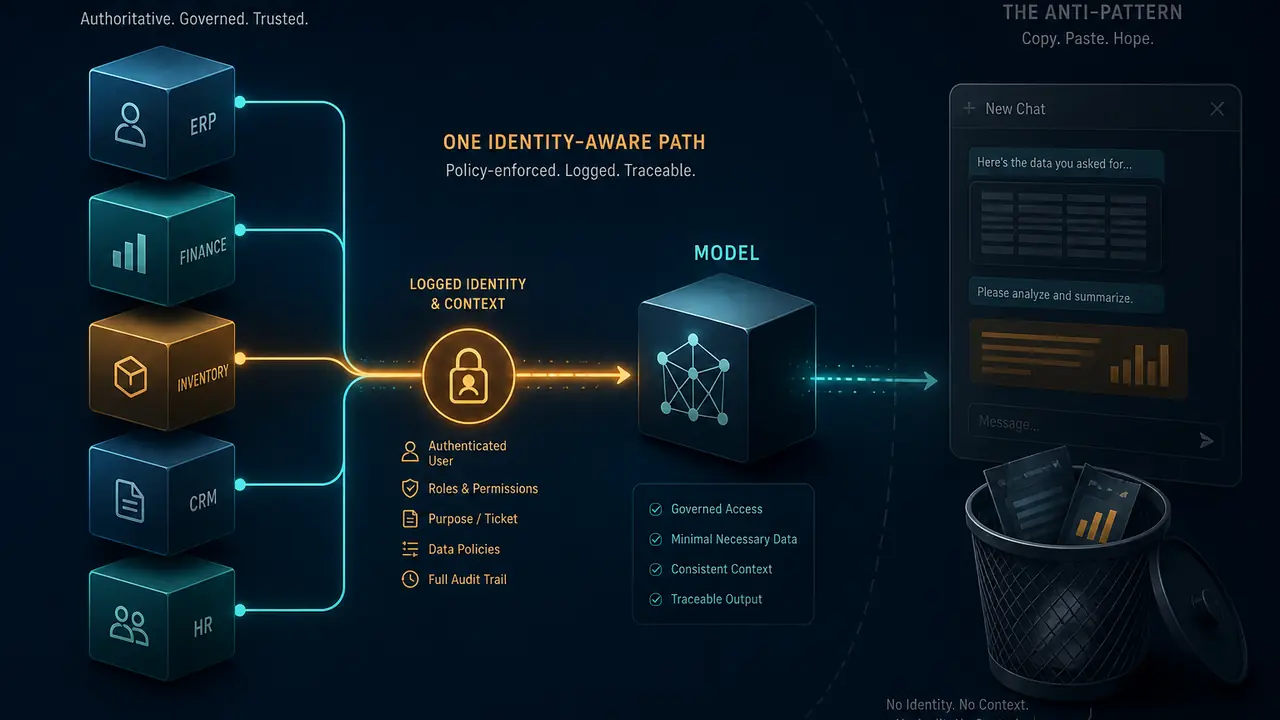
Enterprise AI integration patterns
Enterprise AI integration is identity, the system of record, and a logged path for every model call. A chat UI that makes people copy-paste is not a pattern. It is a workaround.
Read more →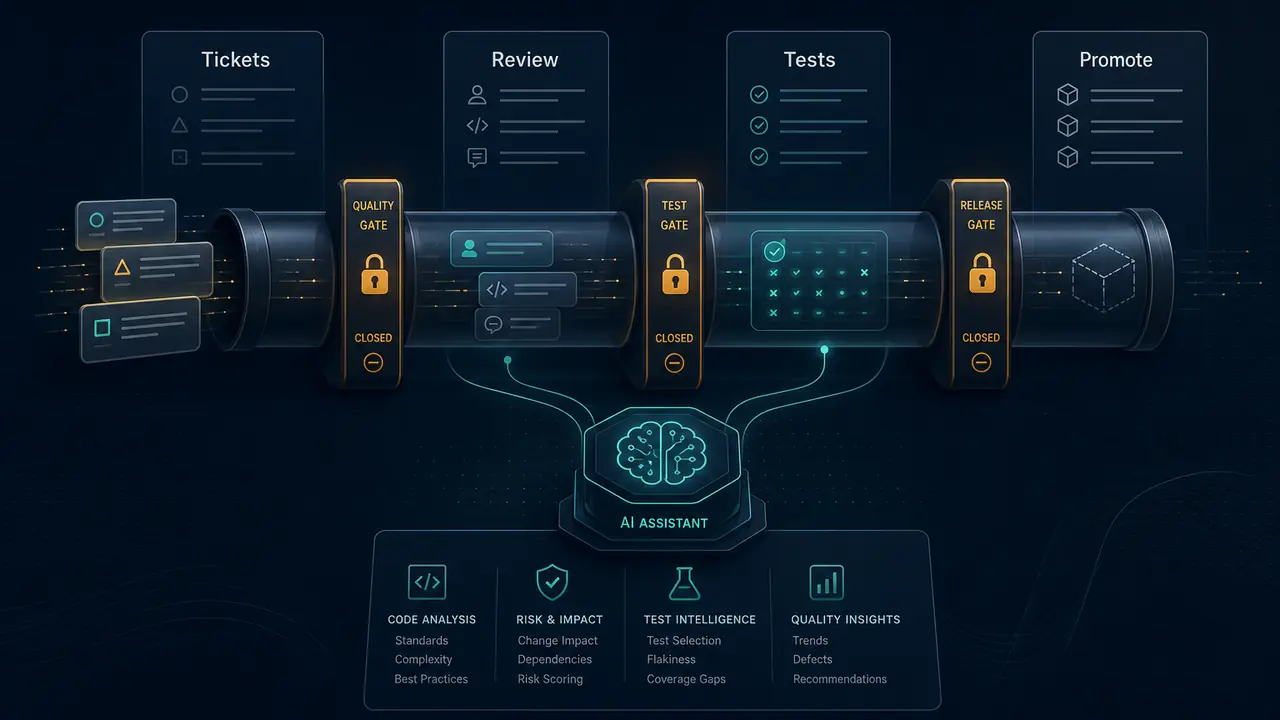
AI-powered SDLC
An AI-powered SDLC puts assistants in the pipeline you already have: tickets, review, tests, and promote. It is not a chat window next to git. Eval and write-gates still apply.
Read more →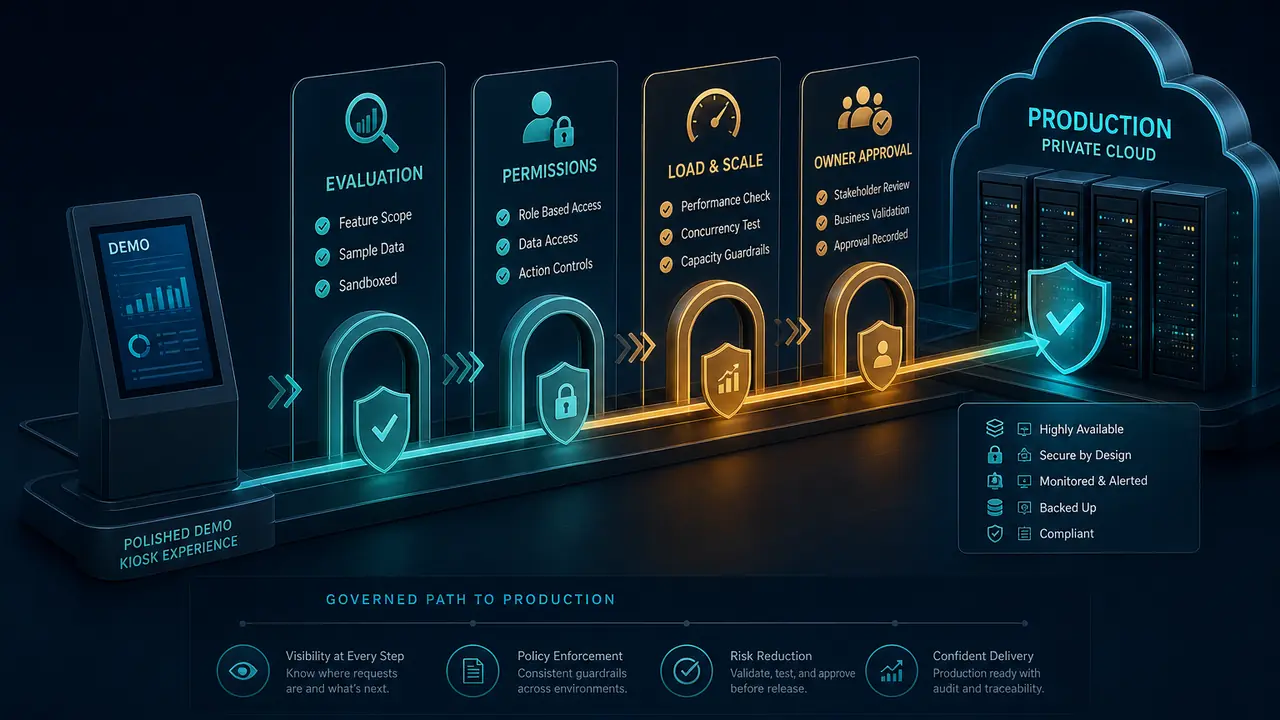
Productionizing AI applications
Productionizing AI is eval, permissions, load, and an owner — not a nicer demo. Take the stalled POC into your repos and your cloud, or stop calling it production.
Read more →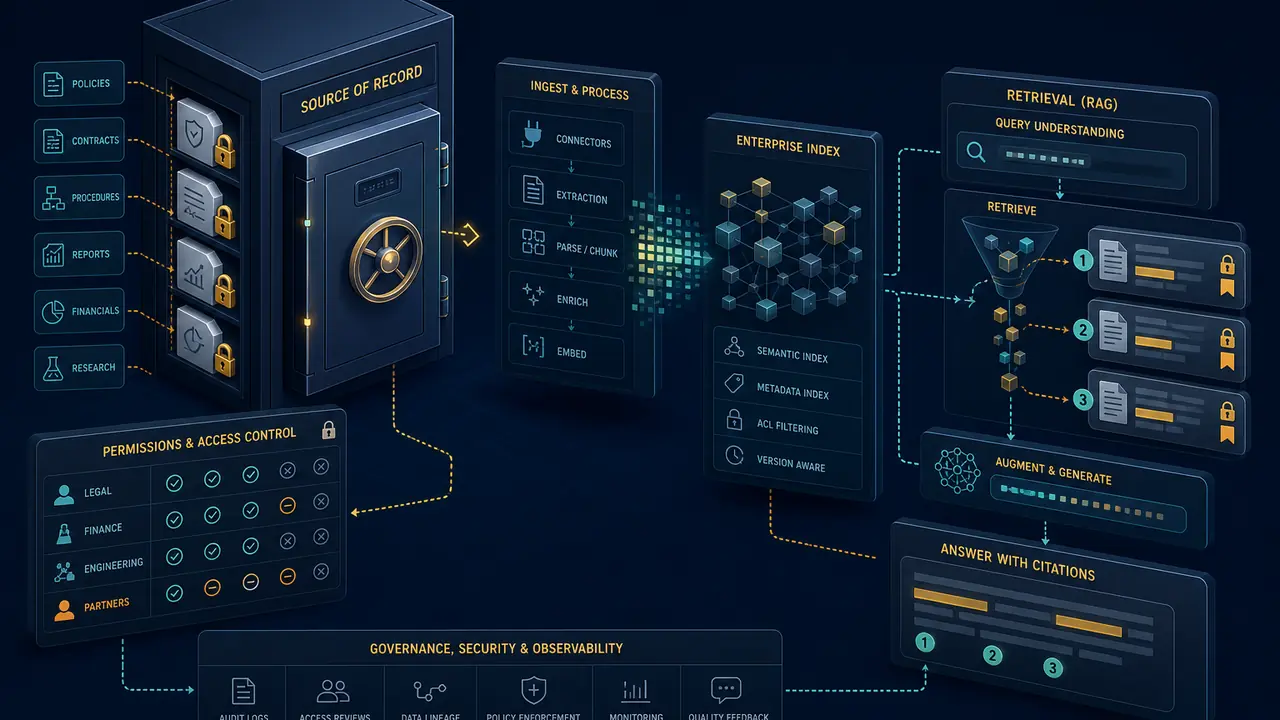
RAG development for enterprise
Enterprise RAG is retrieval over your source of record, with permissions, eval, and citations. A chat box on a zip of exports is not a knowledge system.
Read more →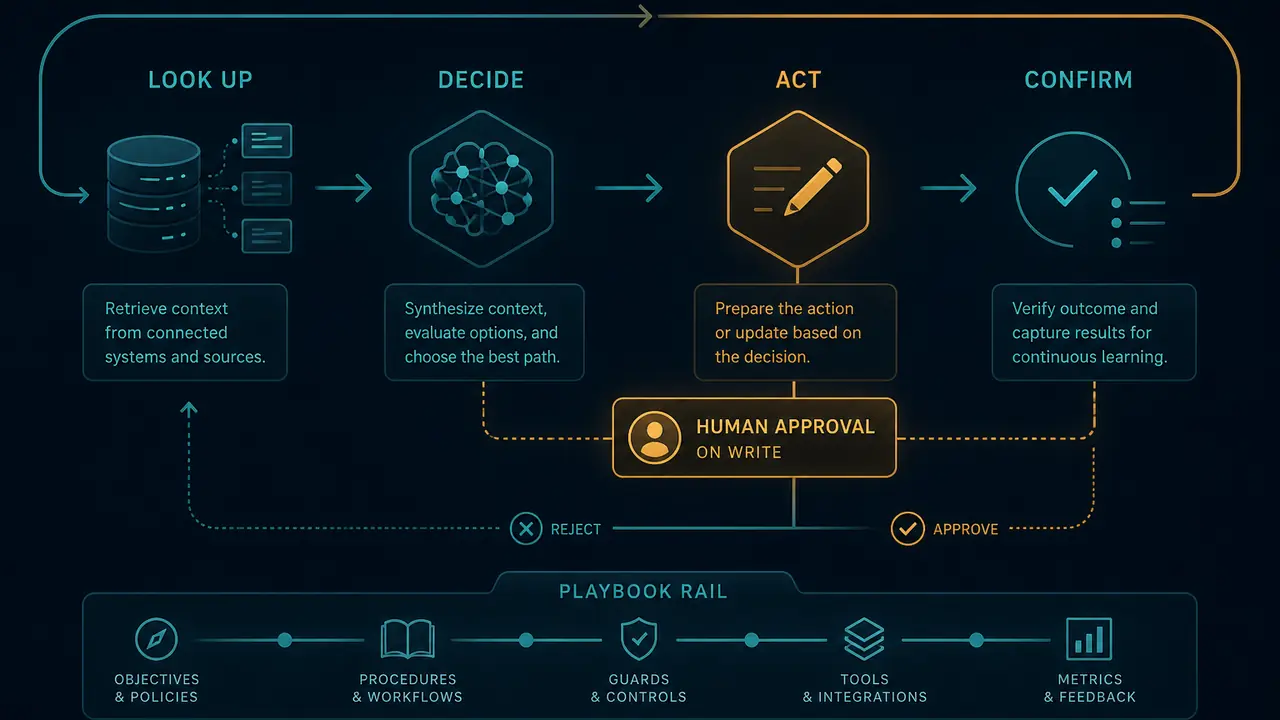
AI agent development
An AI agent completes work: look up, decide, act, confirm. A chatbot writes a paragraph. Build agents on one high-volume playbook, in shadow mode, with a human on sensitive writes.
Read more →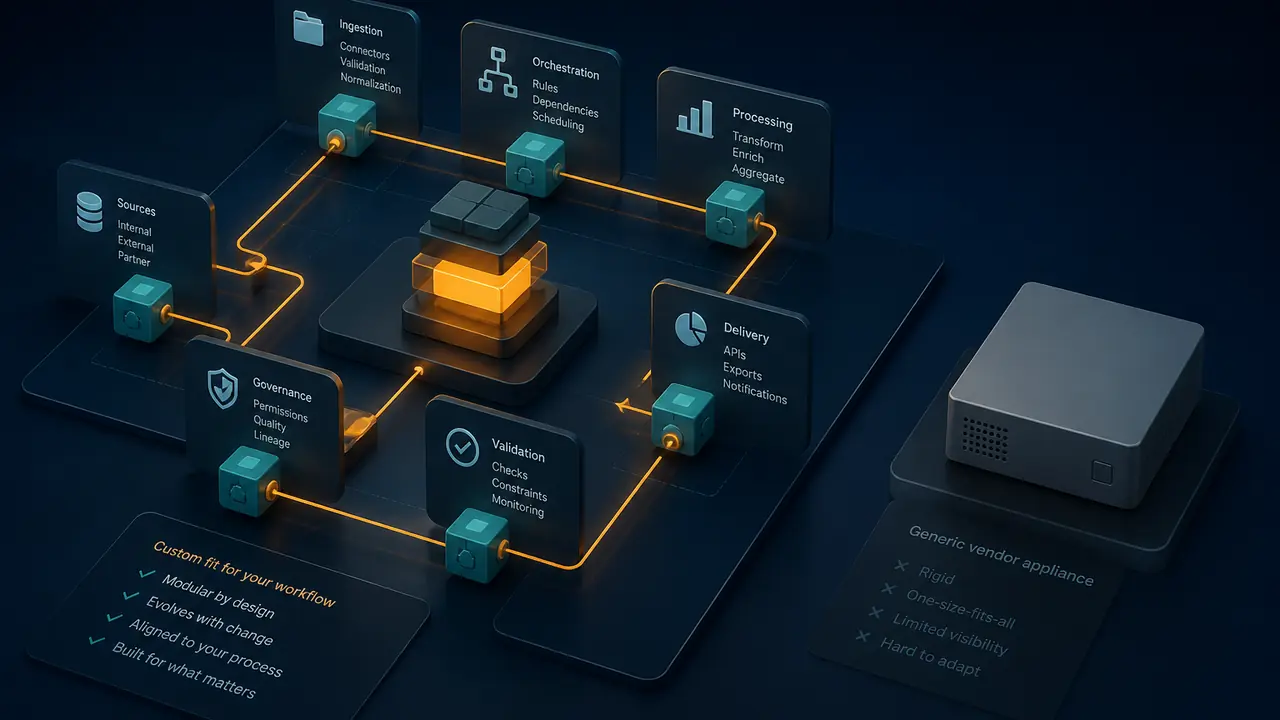
Custom AI development
Custom AI development is software around the workflow no vendor will ship. Build when the process is your edge. Own the repos. Productionize the demo that cannot survive real users.
Read more →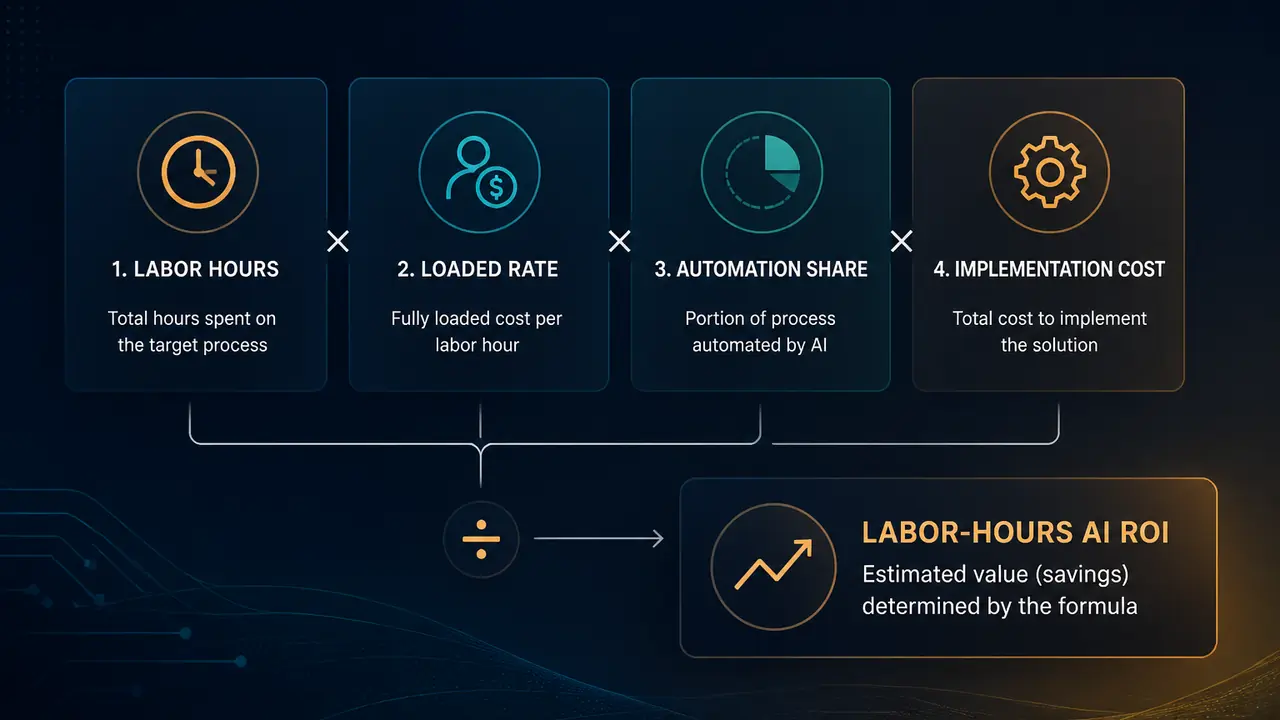
How to calculate AI ROI
Calculate AI ROI from labor hours only: loaded hourly rate, hours per year, automation share, and implementation cost. The formula is public. The defaults are not a customer result.
Read more →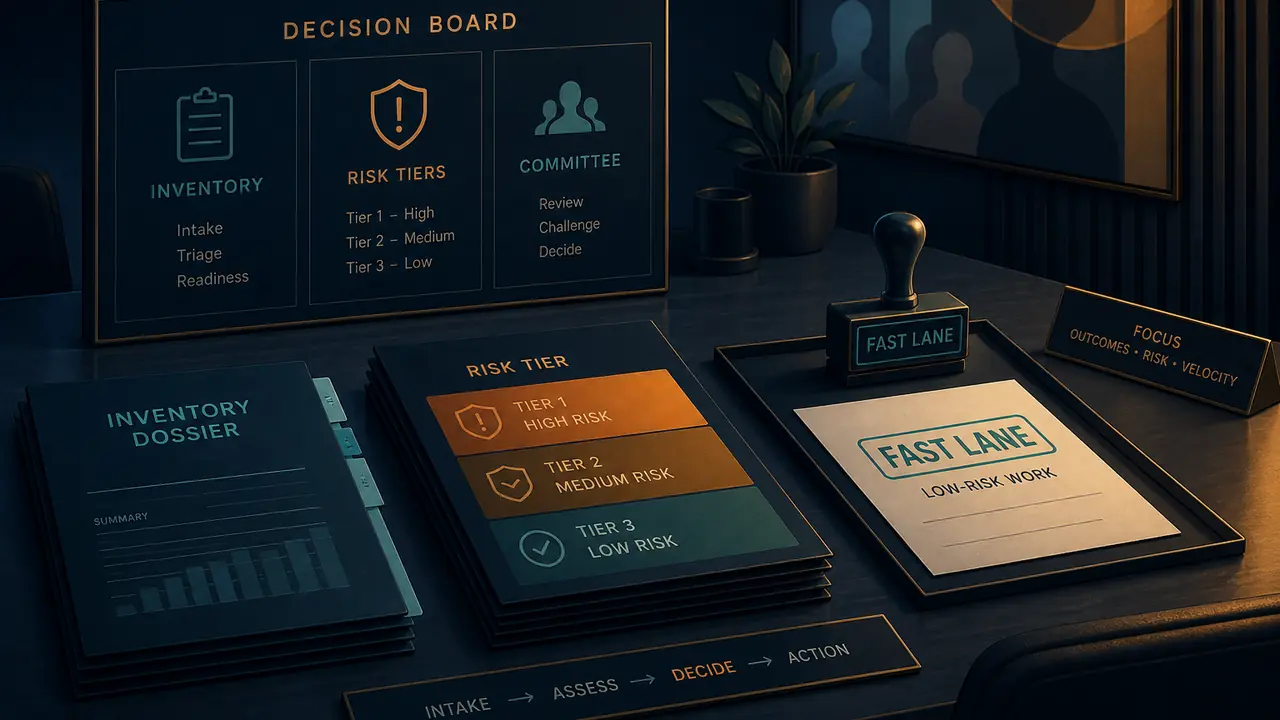
How to establish an AI governance committee
Stand up a small AI governance committee that unblocks low-risk work in days, owns the inventory and tiers, and only convenes heavily when data class or write-back risk is high.
Read more →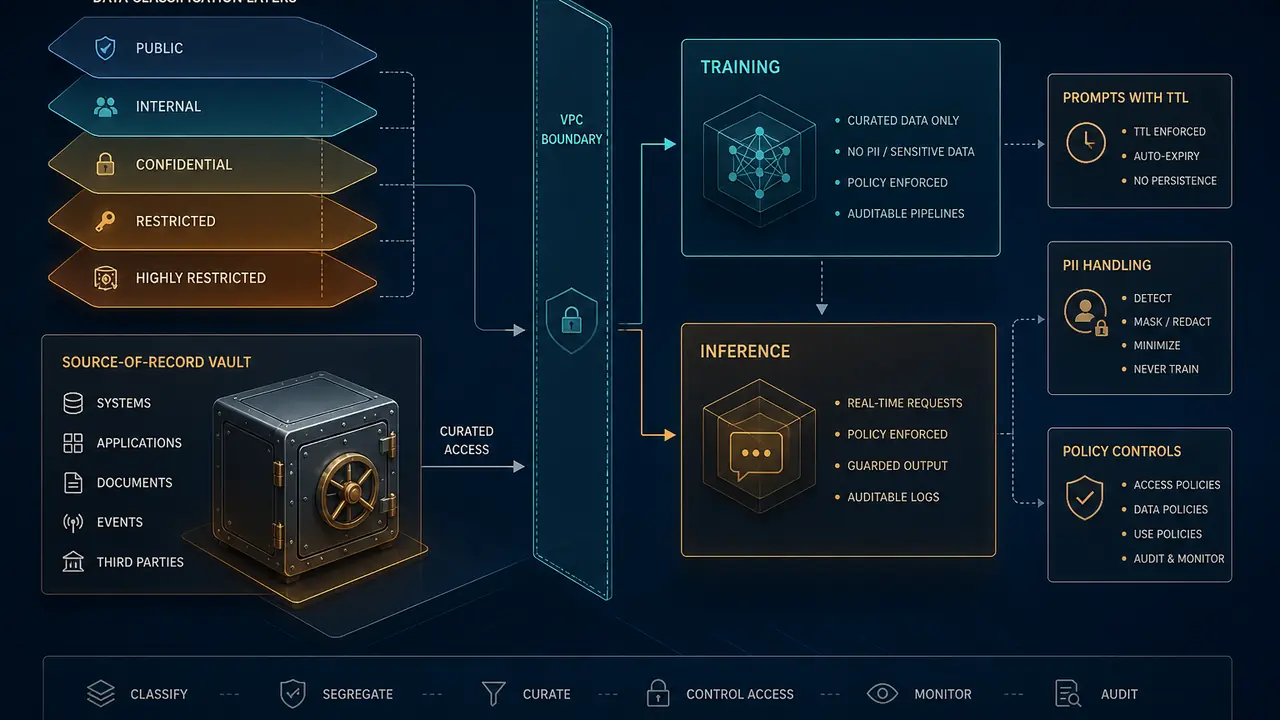
AI data governance
Decide the source of record, who may see it, what can be used for training versus inference, how long prompts stay, how PII is handled, and what is allowed to leave the VPC.
Read more →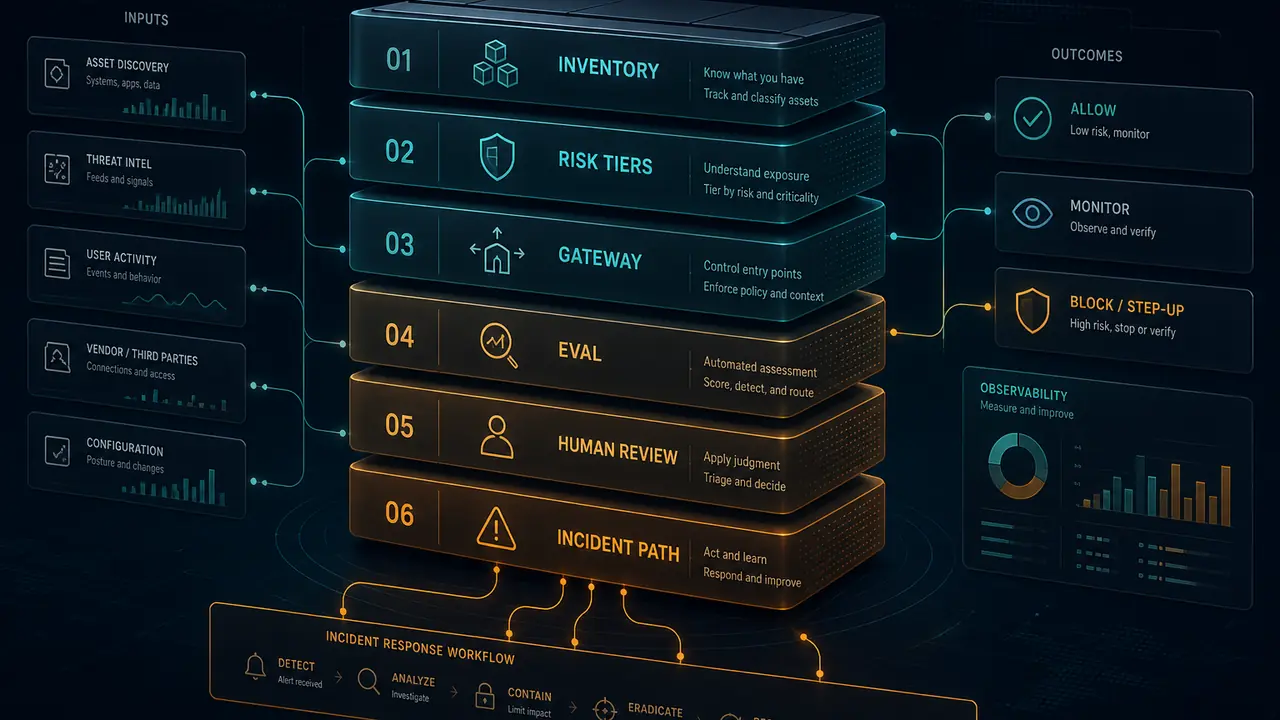
Responsible AI framework
A responsible AI framework is a set of controls you can operate: inventory, risk tiers, gateway, eval, human review, and an incident path — not a values essay.
Read more →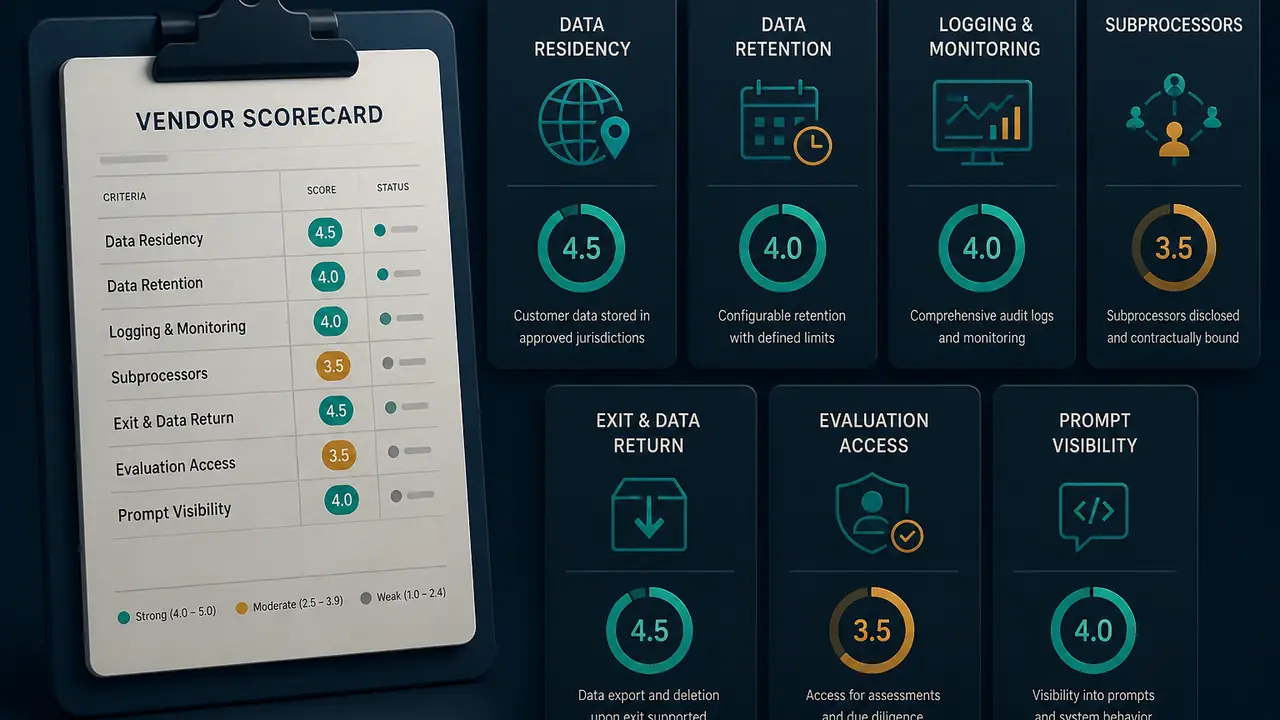
AI vendor evaluation framework
Score an AI vendor on data residency, retention, logging, subprocessors, exit, eval access, and who can see your prompts — before the pilot becomes the production path.
Read more →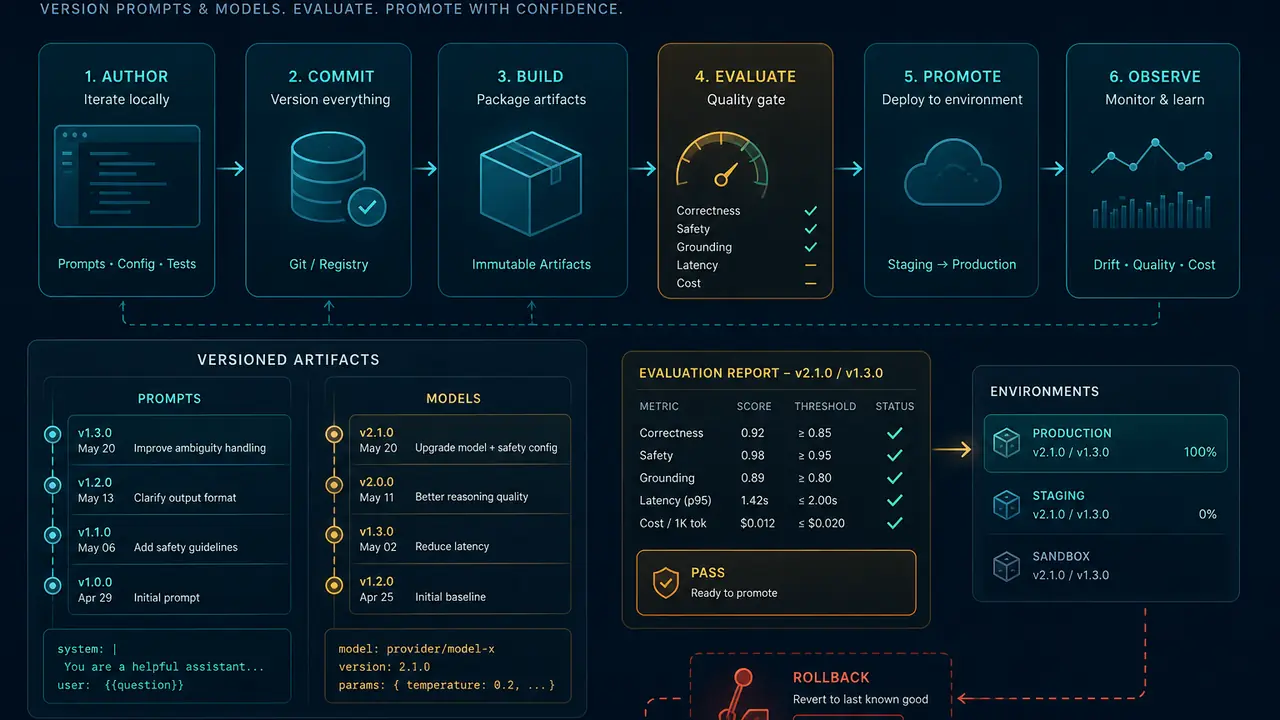
AI governance for software developers
Governance that lives in the pipeline: prompts and models as change-controlled artifacts, eval before promote, human-in-the-loop on high-risk write-backs, production logs, and a rollback you can actually run.
Read more →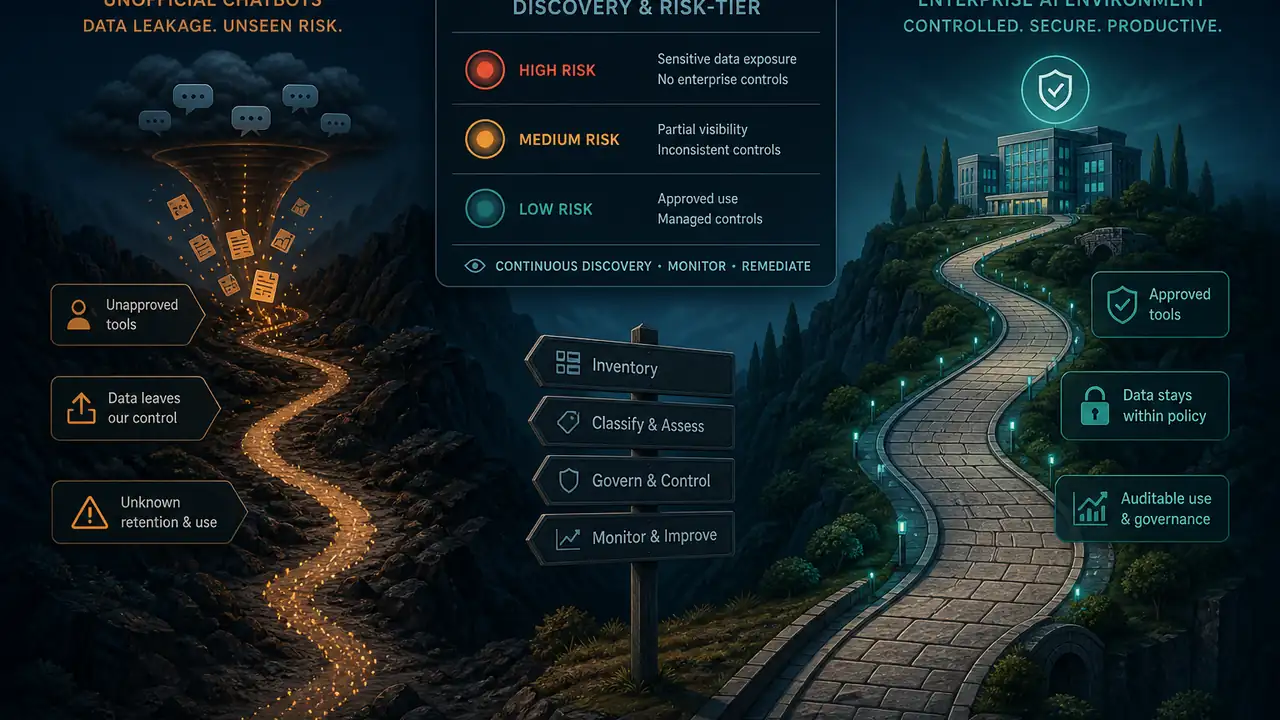
Shadow AI risks
Employees are already pasting work into public chatbots. How to discover shadow AI, risk-tier it, and pave or kill — without treating every unofficial tool as a moral failure.
Read more →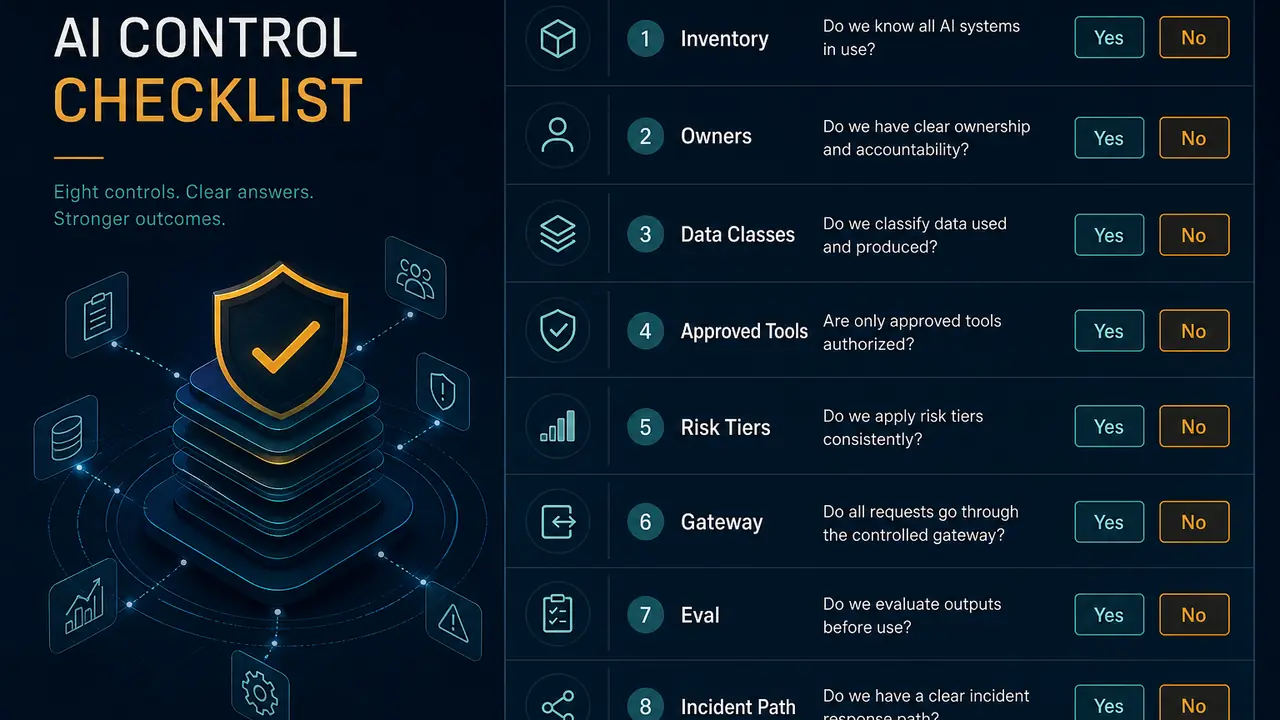
AI governance checklist
A yes-or-no checklist of what must exist before you call AI governed — inventory, owners, data classes, approved tools, risk tiers, gateway, eval, incident path, and review cadence.
Read more →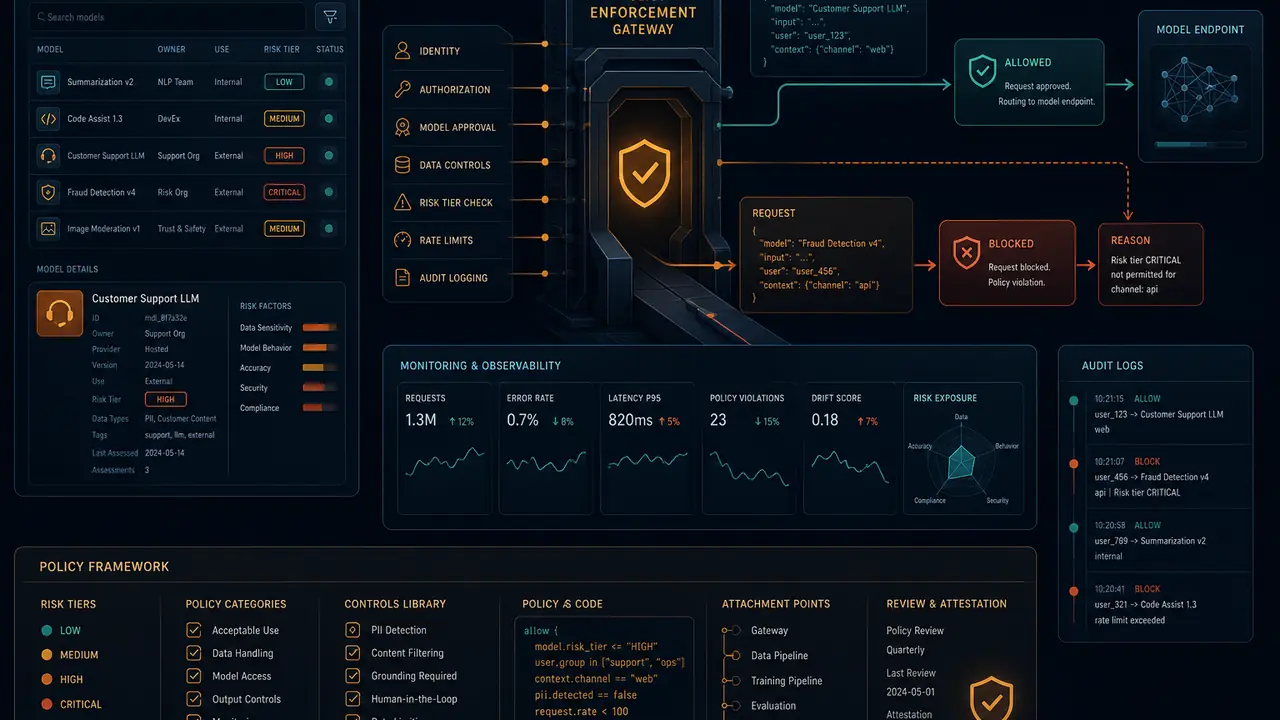
Enterprise AI governance framework
You already have AI in production—often without an inventory, an owner, or an audit trail. This framework turns governance into engineering: discover every model, risk-tier it, enforce policy at the gateway, and keep monitoring what the board will ask about.
Read more →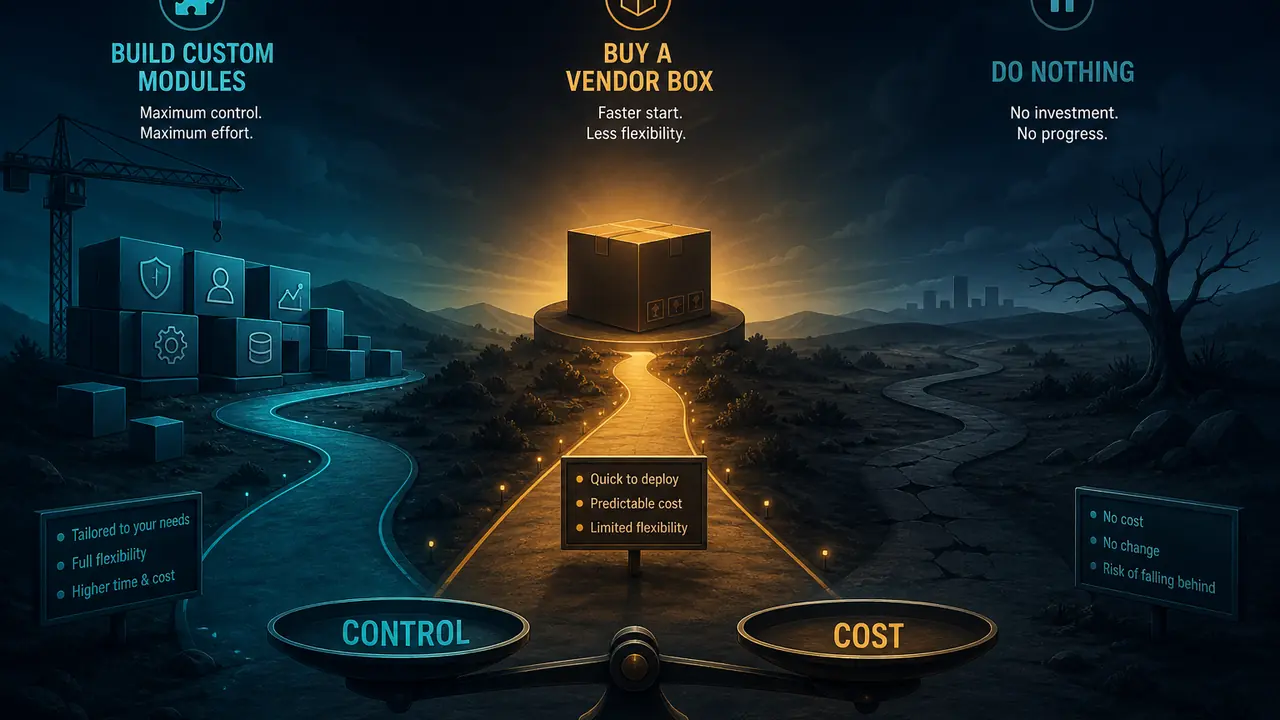
Build vs buy AI
Build vs buy for AI is total cost, control, and whether the workflow is your edge. Put do-nothing on the same page. Kickbacks make the math a lie.
Read more →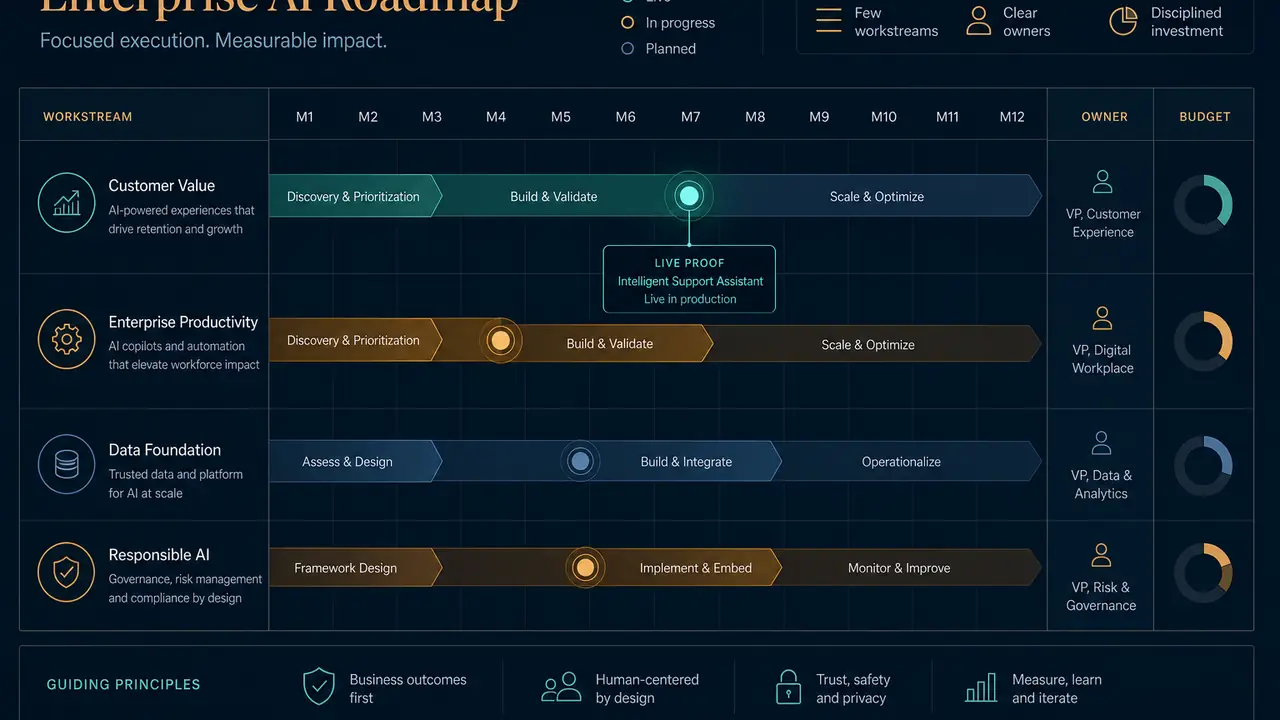
What an enterprise AI roadmap should contain
An enterprise AI roadmap is a 12-month sequence with owners, budgets, and one live proof. A slide of forty initiatives is not a roadmap.
Read more →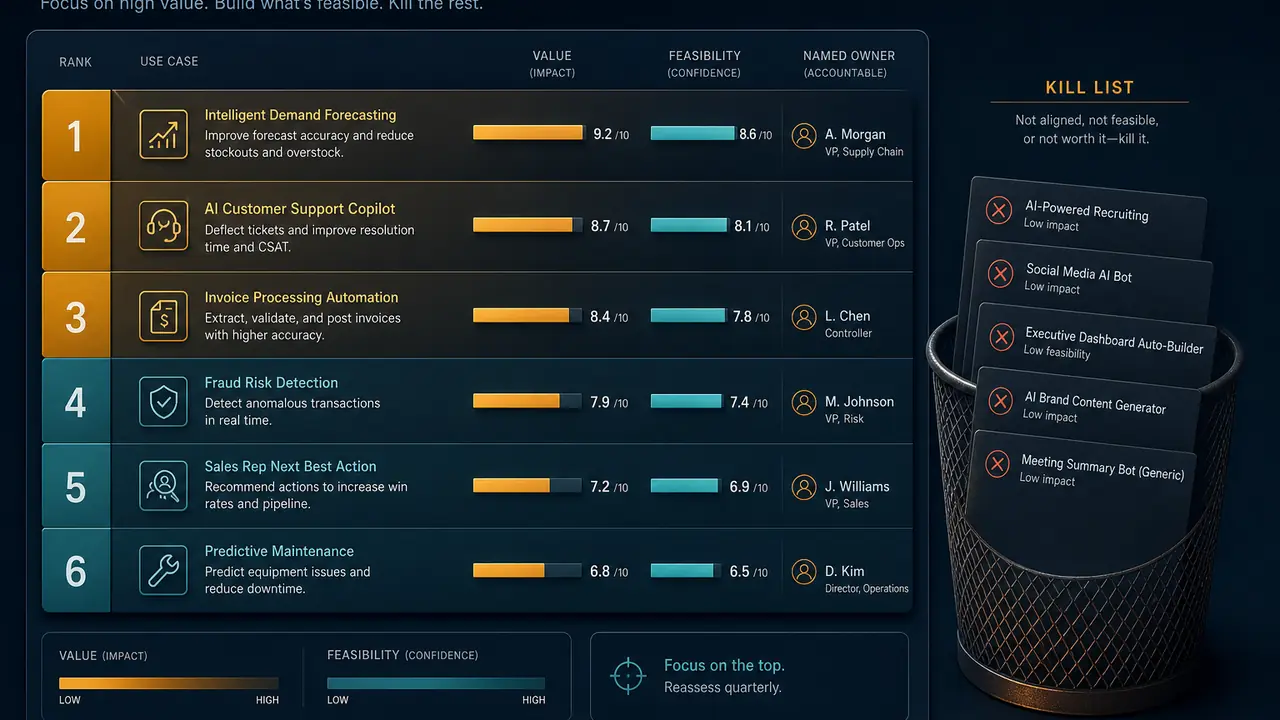
How to prioritize AI use cases
Prioritize AI use cases by value, feasibility, and a named owner. Kill the rest. A ranked list with no kill list is a wish list.
Read more →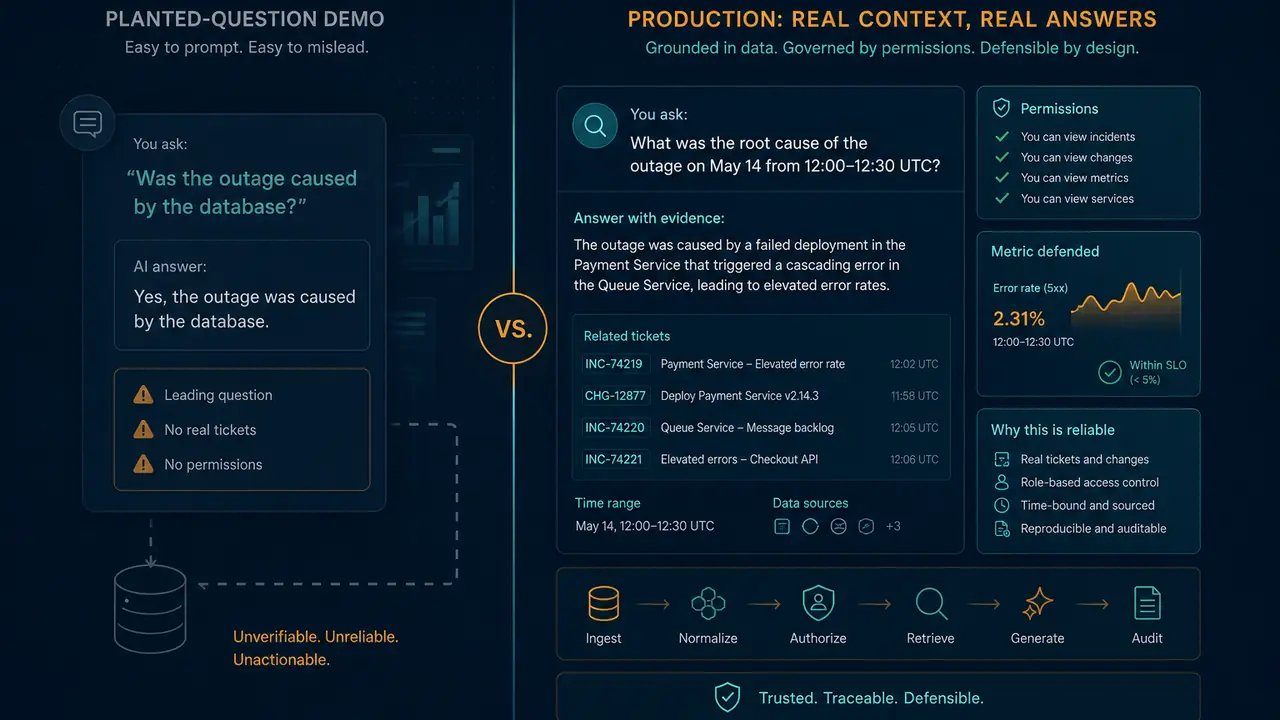
AI proof of concept vs production AI
A proof of concept answers a planted question. Production AI survives real tickets, real permissions, and a number you can defend.
Read more →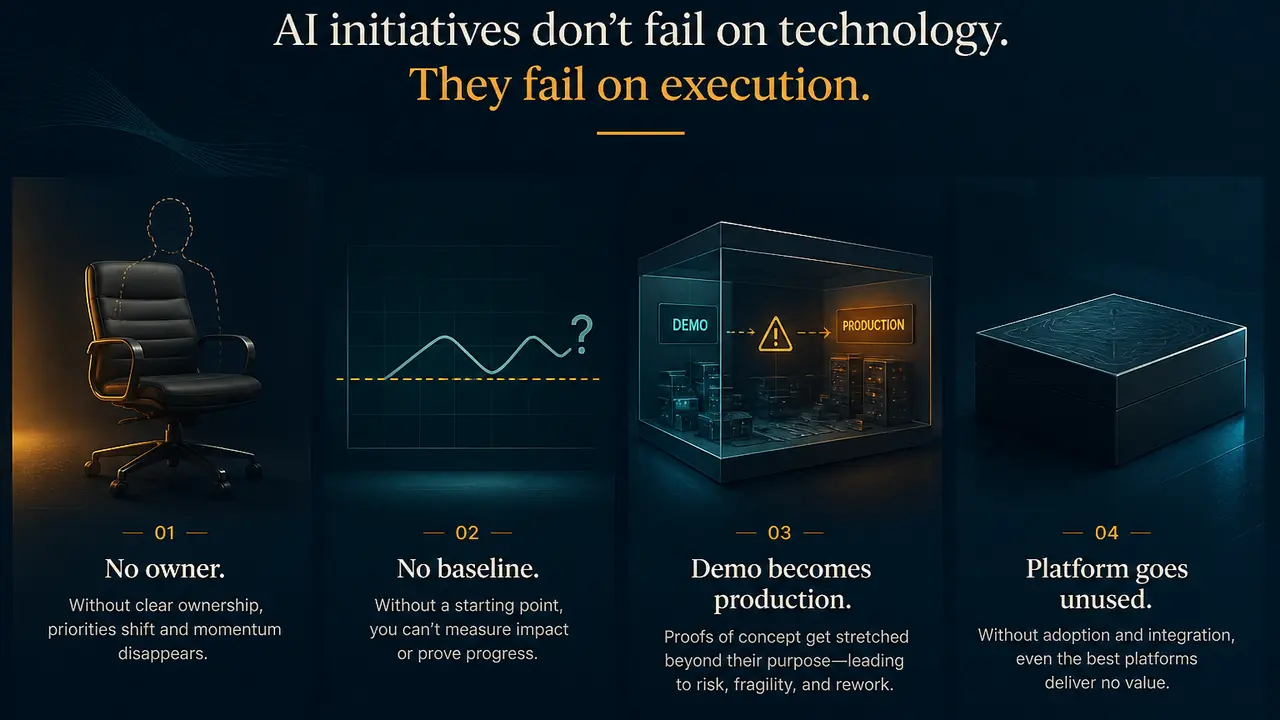
Common enterprise AI implementation failures
Enterprise AI fails in the same few ways: no owner, no baseline, a demo treated as production, and a platform bought to skip the first workflow.
Read more →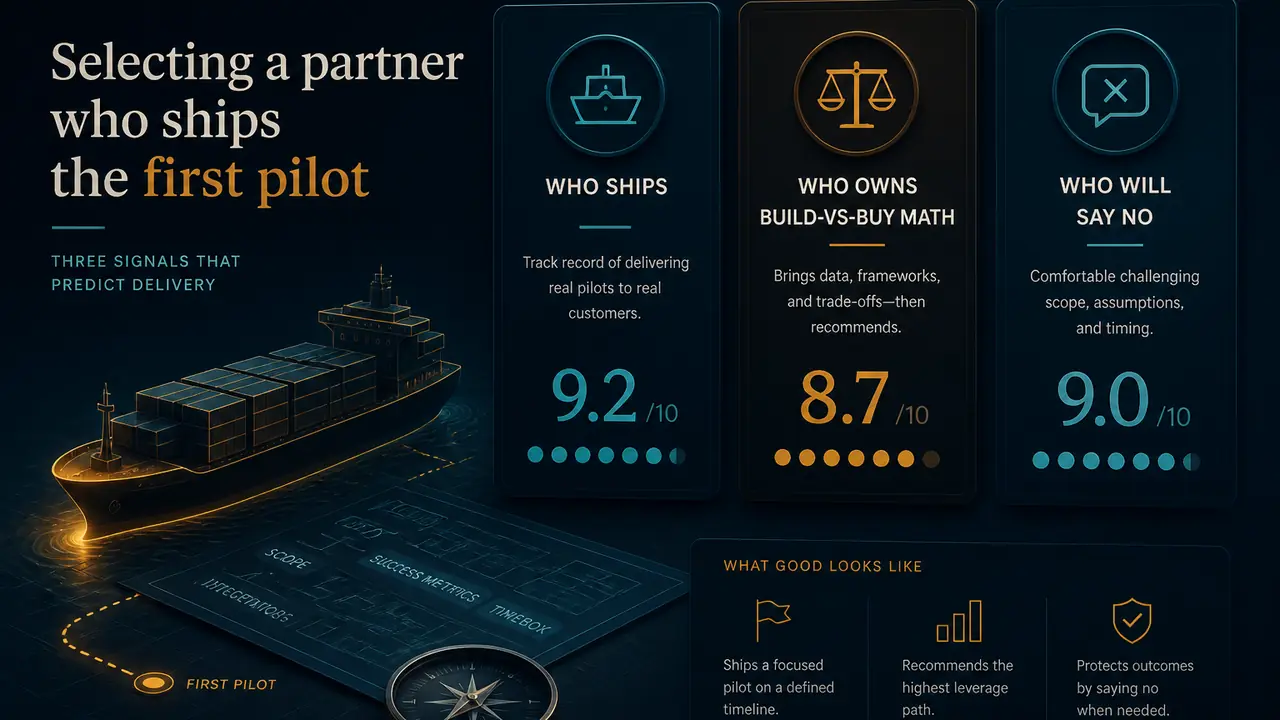
How to choose an AI consulting company
Choose an AI consulting firm by who ships the first pilot, who owns the math on build vs buy, and who will tell you not to start.
Read more →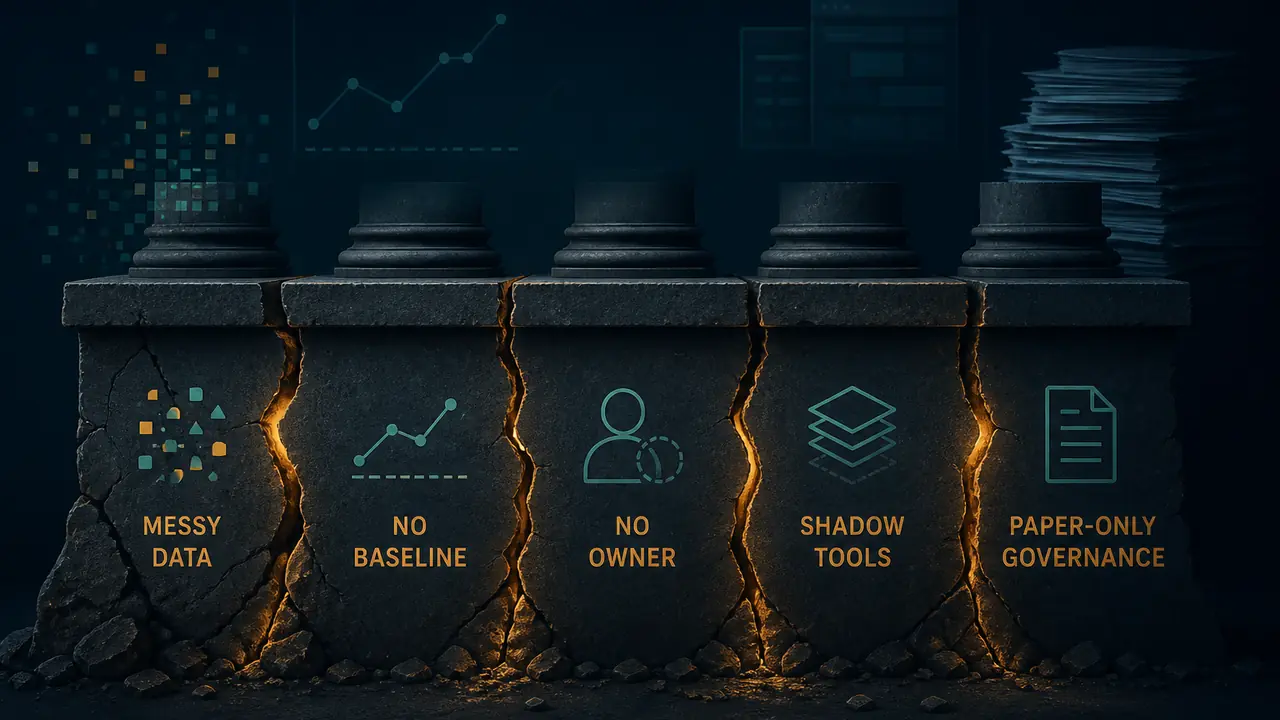
Common AI readiness gaps
The readiness gaps that kill first AI workflows: messy data, no baseline, no owner, shadow tools, and governance that exists only on paper.
Read more →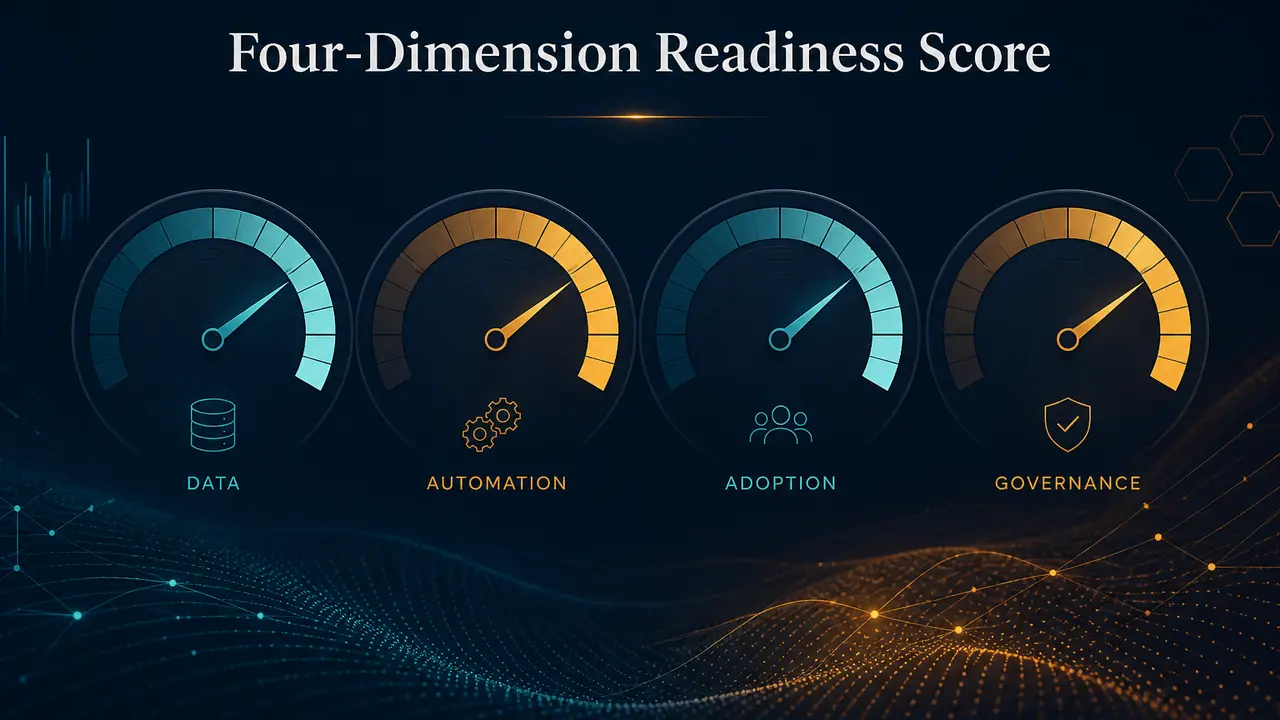
How to measure AI readiness
Measure AI readiness on four dimensions: data, automation, adoption, and governance. Score them before you buy a platform or staff a council.
Read more →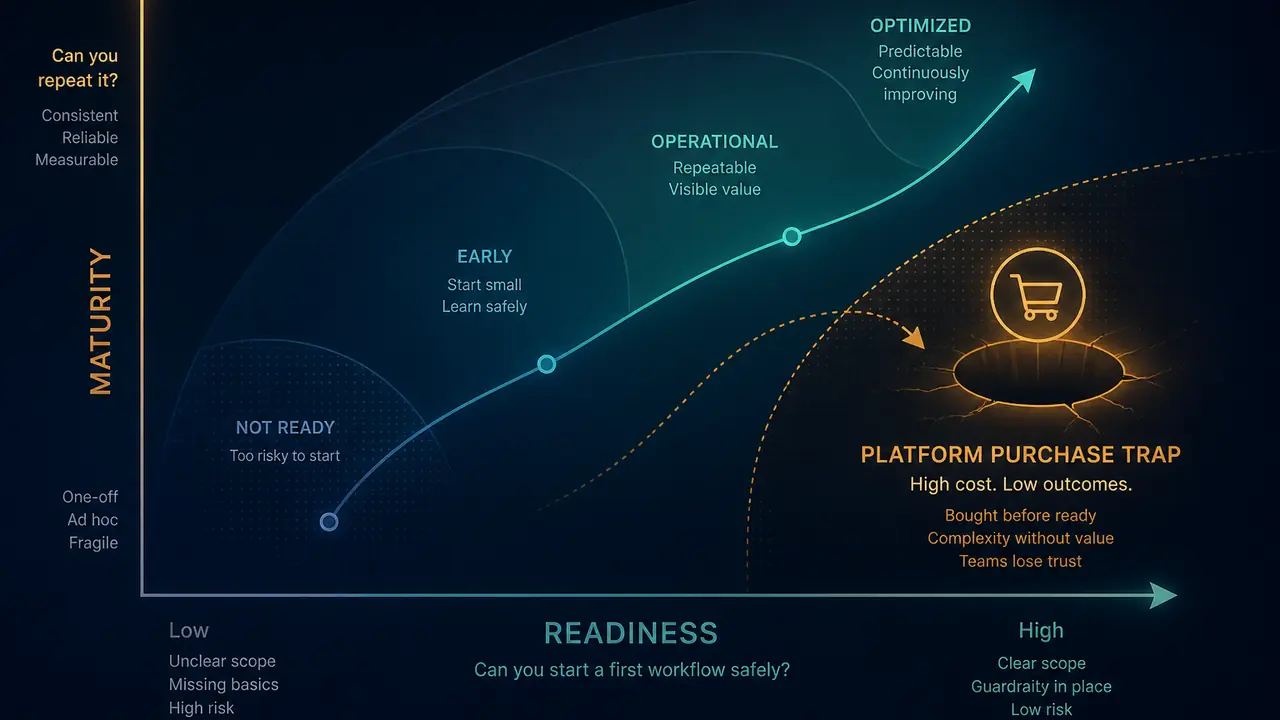
AI readiness vs AI maturity
Readiness is whether you can start a first workflow safely. Maturity is whether you can repeat it. Mixing them up is how you buy a platform you cannot run.
Read more →
How to measure Fractional CAIO ROI
Fractional CAIO ROI is hours returned, vendors killed, and pilots finished or buried. If you cannot name the number before month two, do not buy the retainer.
Read more →
What a Fractional CAIO costs
A full-time CAIO is $250K to $350K fully loaded. Fractional is a monthly retainer for 8 to 20 hours. Here are honest ranges, and what should never be a SKU.
Read more →
Fractional CAIO 30/60/90-day plan
A 30/60/90 plan for a fractional CAIO: baseline and kill-list in month one, first live workflow in month two, board-ready ownership in month three.
Read more →
When to hire a Fractional CAIO
Hire a fractional CAIO when AI decisions already have a desk and no owner. Skip it if you only need a pilot or a deck.
Read more →
Fractional CAIO vs AI consultant
A consultant ships a project and leaves. A fractional CAIO owns the roadmap, vendors, and results month after month. Here is how to pick.
Read more →
What is a Fractional CAIO
A fractional Chief AI Officer is a part-time senior AI leader who owns strategy, vendors, and delivery for 8–20 hours a month, without a $250K executive hire.
Read more →
7 reasons enterprise AI never leaves the demo
Seven failure modes that keep enterprise AI in a slide deck, and the one-workflow test that gets the first system into production.
Read more →
Revolutionizing Car Dealerships: The Power of AI Integration
Explore how AI is transforming car dealerships by enhancing customer experiences, streamlining operations, and driving sales through innovative solutions.
Read more →
Revolutionize Your Real Estate Business with AI Solutions
Explore how real estate agents can leverage AI for social media management, automate tasks, and enhance client engagement with innovative solutions.
Read more →
Transforming Commercial Flooring with AI: A Path to Success
Explore the transformative impact of AI in the commercial flooring industry and learn how to implement it for enhanced efficiency and customer satisfaction.
Read more →
Transform Your Roofing Business: Harness AI for Efficiency & Accuracy
Explore how AI is transforming the roofing industry by enhancing efficiency and accuracy through innovative tools like drones and data analytics.
Read more →
Top Reasons AI Chatbots Are Essential for IT Operations in 2025
Learn why AI chatbots should be a priority for IT operations in 2025, enhancing efficiency, user satisfaction, and strategic capabilities.
Read more →
Unlocking the Power of AI Consulting for Small Businesses
Explore the benefits of AI consulting services for small businesses, from enhancing efficiency to driving innovation. Learn how to leverage AI for growth.
Read more →
Embrace the Future: Top AI Trends to Watch in 2025
Discover the key AI trends for 2025 with Mufasa Labs, from generative AI to enhanced customer experiences and automation, shaping the future of technology.
Read more →
Safeguarding Academic Integrity: How AI Fights Plagiarism
Discover how Mufasa Labs' AI technology helps schools combat plagiarism and AI-generated content, ensuring academic integrity in education.
Read more →
Transform Your Legal Practice: Harness AI for Leads and Onboarding
Explore how AI can revolutionize lead qualification and client onboarding for lawyers, improving efficiency and client satisfaction in legal practices.
Read more →
Unlocking Effortless Knowledge Base and CRM Integration Today!
Explore how advancements in technology make knowledge base and CRM integration seamless, enhancing IT operations and user satisfaction.
Read more →
Transform Holiday Stress into Success with AI Solutions for SMBs
Mufasa Labs’ AI solutions help SMBs tackle holiday stress by personalizing customer experiences, optimizing inventory, and boosting sales. Transform your operations today!
Read more →
Revolutionizing Recruitment: Boost Your Hiring with AI Solutions
Explore how Mufasa Labs' AI revolutionizes recruitment by streamlining hiring, mitigating bias, and improving candidate engagement for better talent acquisition.
Read more →
Transform Your IT Support with Mufasa Labs' AI Solutions
Discover how Mufasa Labs' AI solutions can elevate your IT support with 24/7 assistance, empowering users, and streamlining operations for greater efficiency.
Read more →
Transforming Holiday Shopping: How AI Will Revolutionize Black Friday
Discover how AI is transforming holiday shopping, making Black Friday stress-free with personalized experiences, efficient inventory management, and faster checkouts.
Read more →
Discover Key AI Insights from Microsoft Ignite 2024
Explore transformative AI insights from the Microsoft Ignite Conference 2024, showcasing industry advancements and Mufasa Labs' consulting services.
Read more →
How AI is Transforming Halloween Retail for Maximum Impact
Discover how AI is reshaping Halloween retail through personalized shopping experiences, better inventory management, and innovative pricing strategies.
Read more →
Revolutionize Your HVAC: Harness AI for Ultimate Efficiency
Discover how AI is revolutionizing HVAC systems, enhancing efficiency, predictive maintenance, and energy savings for a more comfortable environment.
Read more →
Want this working in your business?
Every post on this blog comes from systems we've actually built. Book a 30-minute call and we'll map the same playbook to your stack.