
Common AI readiness gaps
The readiness gaps that kill first AI workflows: messy data, no baseline, no owner, shadow tools, and governance that exists only on paper.
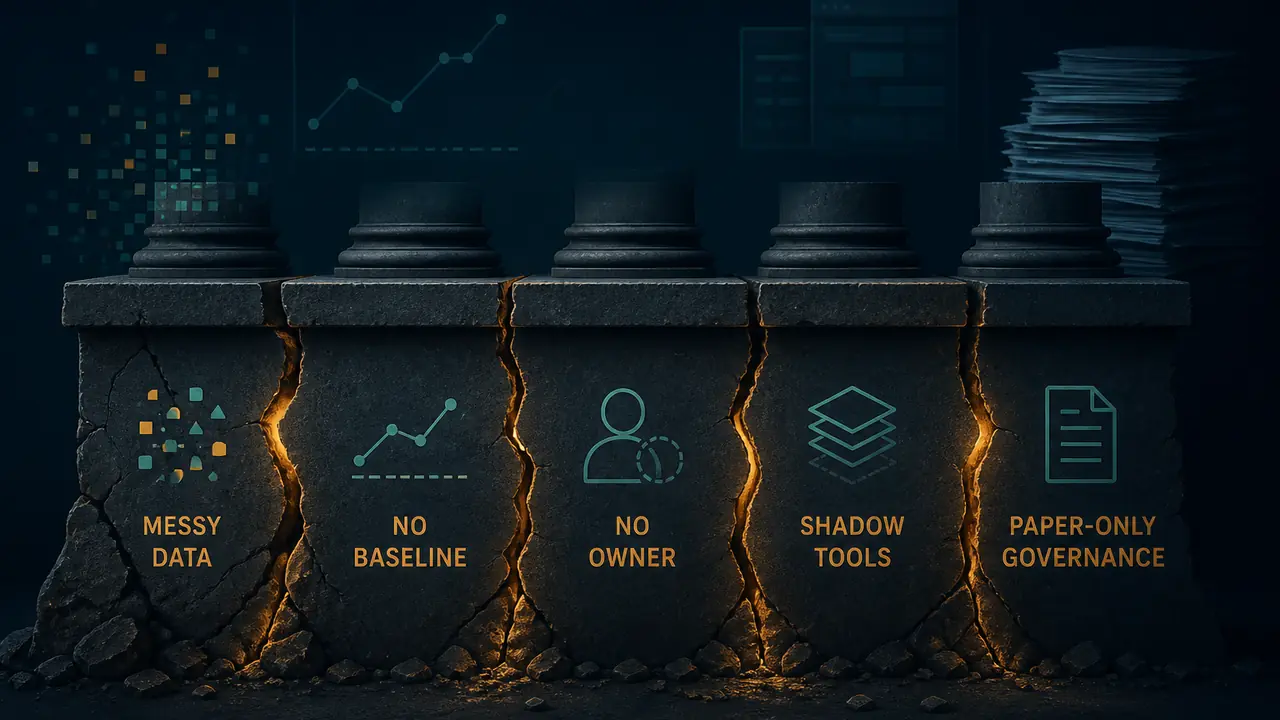
Most first AI projects do not die because the model is weak. They die because one of a short list of gaps was ignored. The same four dimensions show up every time: data, automation, adoption, and governance. If you want the score before you read, take the 3-minute AI Readiness Assessment. This is what the low scores usually mean.
Data gaps: the model cannot see the live record
The workflow's truth is split across a ticket queue, a share drive, and a spreadsheet named final. The assistant cites a 2022 PDF. The desk uses a rule that changed in Slack last month. Users do not ask for a better prompt. They stop.
Permissions are unknown. Either the model is blind or it can see files the user cannot. Both fail an auditor.
There is no owner for the source. When two systems disagree, nobody is paid to say which one wins. Retrieval will pick at random and sound confident.
A ready data score is not a lake. It is one system of record for the first workflow, an access list, and a way to tell stale from live. If you do not have that, the next spend is access, not a model.
Automation gaps: no painful step with a number
The only use case on the slide is "an assistant for the company." That is not a step. It has no cycle time, no error rate, and no owner.
Nobody wrote the baseline. After the demo, there is nothing to compare. Finance cannot defend the next dollar.
The candidate happens twelve times a year. A custom system will not pay for itself. The honest next step is nothing, or a cheaper tool.
The step lives in a system you do not own yet. You are not ready to automate. You are ready to buy a platform for its own sake. Pick a desk job that already runs in your stack: intake, review, a weekly report.
Adoption gaps: no named user for the output
A steering committee is not a user. The adjuster, paralegal, or scheduler is. If they were not in the room when you defined done, they will keep the old spreadsheet.
Nobody has said what happens when the model is wrong. The first live miss becomes a quiet boycott.
Shadow use of public chats is counted as "people are excited." It is the opposite. Official tools are too slow or missing, so work is leaving the tenancy.
Training was a lunch-and-learn. Adoption is whether a named person will put the output in front of a customer or a regulator. If that person cannot be named, you are not ready.
Governance gaps: you cannot say yes or no this week
There is a 40-page policy and no allow list. Employees paste customer data into public models anyway.
Legal has not seen how retrieval gets files. Security has not seen the logs. The board has been told "we have AI governance." You have a PDF.
Approvals take months for a low-risk internal summary and days for an unsanctioned tool. The paved road is slower than the dirt path, so everyone uses the dirt path.
Ready governance is short: approved tools, banned data classes, a person who can approve low-risk use in days. The mature form is a gateway, inventory, and risk tiers. Do not wait for that build to write the first rules.
How to use the gaps
Score each dimension. The lowest one is the constraint. Do not average four mediums into a green dashboard.
If data is the floor, fix the source and access for one workflow. If automation is the floor, pick a smaller step and write the baseline. If adoption is the floor, find the user before you buy licenses. If governance is the floor, publish the allow-and-deny list this week.
That is the same order we use in how to measure AI readiness. Readiness is the gate. Maturity is whether the second workflow is cheaper. Do not buy a maturity journey to paper over a gap you have not named.
Take the 3-minute AI Readiness Assessment if you want the four-dimension score before the next vendor meeting.
