
What an enterprise AI roadmap should contain
An enterprise AI roadmap is a 12-month sequence with owners, budgets, and one live proof. A slide of forty initiatives is not a roadmap.
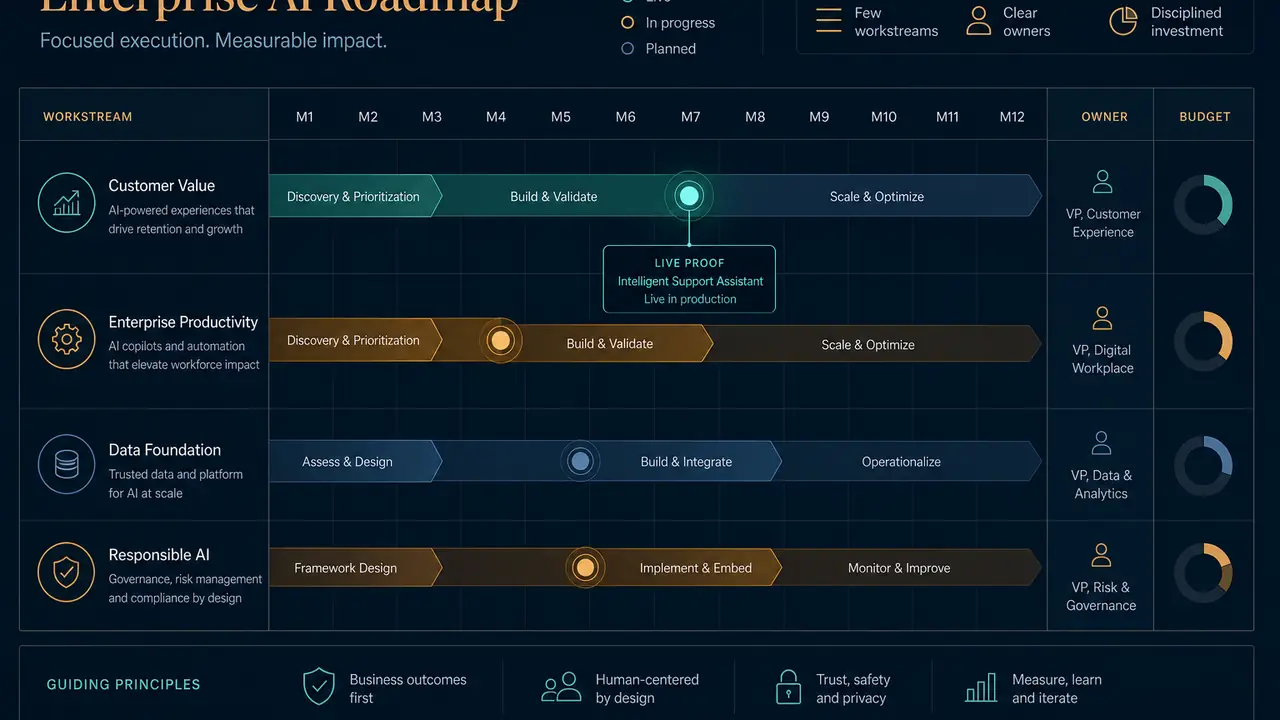
An enterprise AI roadmap is a twelve-month sequence you can staff: owners, rough cost, success metrics, and one proof already in motion. A slide of forty initiatives with traffic-light icons is a mural.
The consulting output we will sign is on enterprise AI consulting: a scored readiness report, a ranked plan, and a working pilot as part of the same engagement. How the ranking gets on that page is how to prioritize AI use cases.
What belongs on the first page
The floor. The readiness constraint: data, automation, adoption, or governance. If the floor is data, the first quarter is access and a system of record, not an agent farm.
The first workflow. Name it. Name the owner of the output. Name the baseline. If this block is vague, the rest of the roadmap is fiction.
The kill list. Vendors and tools you will stop. A roadmap that only adds is a catalog.
The 12-month sequence. Three to seven items, not forty. Each has an owner, a quarter, and a cost band. Anything without those three waits.
Build versus buy for the first two items. Math on the page. No kickbacks behind the recommendation.
Governance that matches the next 90 days. Allow list, deny list, who approves low-risk use. The full gateway can be a later line. The first rules cannot.
Hiring and hours. Who runs this after the consultants leave. If the answer is "the committee," you do not have a roadmap. You have a meeting schedule.
What does not belong
Vision paragraphs. Vendor feature matrices copied from a datasheet. Maturity pyramids with your logo on level two. A year of "enablement" with no live workflow. A platform program whose only customer is the platform team.
If a page does not change a staffing or spend decision, delete it.
How the quarters should feel
Now (90 days). Baseline, kill list, first workflow live or honestly dead. This is the prove step. If this quarter is only workshops, you are still shopping.
Next (months 4 to 6). Second workflow on the same path, or the foundation the first one exposed. Should be cheaper than the first if you actually built a path.
Then (months 7 to 12). Repeatable intake: risk tiers, inventory, evaluation you can rerun. Convert to a standing function or a fractional owner if the CIO cannot carry it.
Do not put "scale to the enterprise" in quarter one. Scale is what you do after a number moved.
Who writes it
The people who will implement it, or it will not survive contact with the stack. A strategy team that cannot sit in the ticket queue will sequence fantasies.
The board gets one page: floor, first workflow, spend, owner. The working team gets the sequence. Do not hand the board the working draft and call that alignment.
How to keep it alive
Revisit monthly. Move dates in public. Add a vendor only if it displaces something on the kill list or beats the next backlog item on value and feasibility.
If after two quarters nothing is live and nothing is killed, throw the roadmap out. You do not need a version 2. You need a smaller first item.
A firm that sells you a roadmap with no pilot in the same statement of work is selling a poster. How we refuse to do that is on enterprise AI consulting.
