
How to prioritize AI use cases
Prioritize AI use cases by value, feasibility, and a named owner. Kill the rest. A ranked list with no kill list is a wish list.
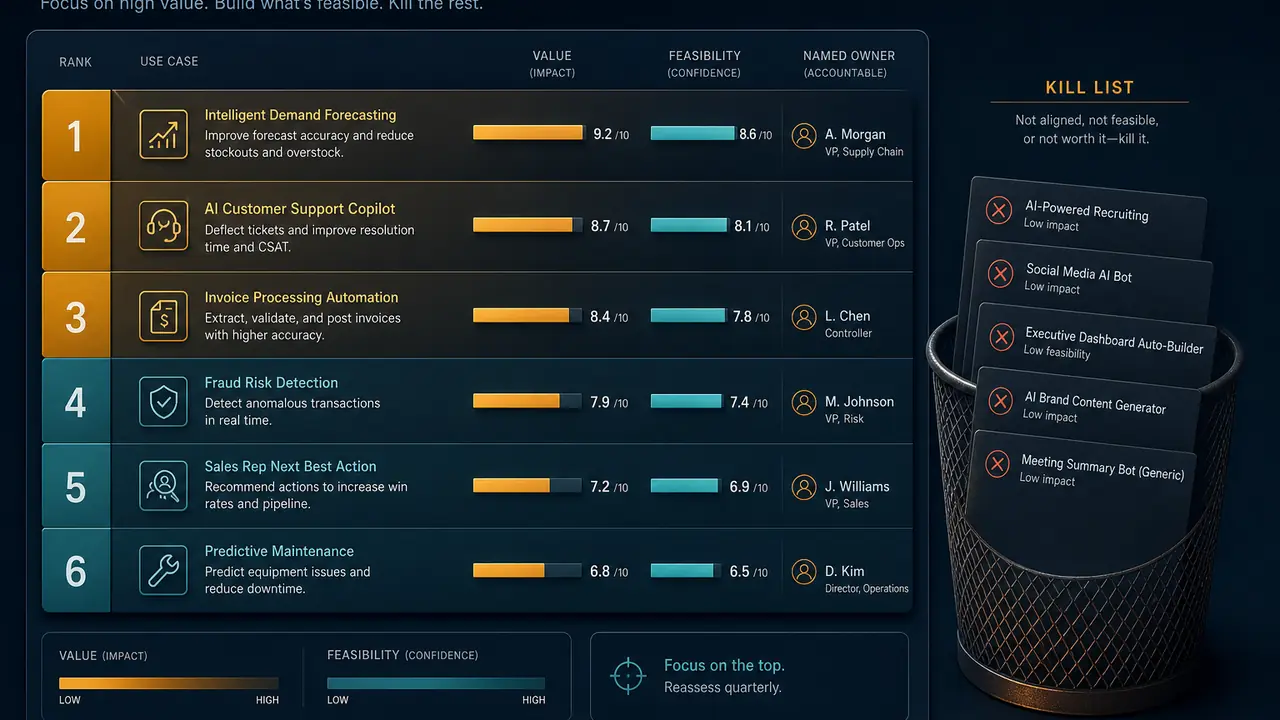
A backlog of twenty AI ideas is not a strategy. It is a way to avoid choosing. Prioritization is value, feasibility, and a named owner, written down, with a kill list. Everything else waits.
This is the workshop step in enterprise AI consulting after the readiness score and before the first pilot. The sequence that holds the ranking is what an enterprise AI roadmap should contain.
Start from a scored floor, not a brainstorm
If data, automation, adoption, or governance is broken, that dimension is the constraint. Score it in minutes before you rank ideas. A beautiful use case on a source you cannot access is not a Q1 item. It is a data project you should name as a data project.
Do not run a sticky-note session that ignores the floor. You will fund the slide that sounded nicest in the room.
Score each candidate on four lines
Value. Hours, cycle time, error cost, or avoided license spend. If you cannot name the unit, the value is a vibe.
Feasibility. Does the data live in a system you own. Can permissions be mapped. Is the step frequent enough to matter. Twelve events a year will not pay for a custom build.
Owner. Who uses the output next week. A sponsor is not an owner. No owner means the idea is not ready to rank.
Risk. What happens when it is wrong. Customer-facing and regulated paths need a human in the loop and a slower first slice. Internal summaries can move faster.
Write the four lines on one page per idea. If a line is blank, the idea is not prioritized. It is unfinished.
Rank, then kill
Sort by high value and high feasibility with a named owner. The top one is the pilot. The next two are the backlog. The rest get a date to revisit or a kill.
Kill means you will not staff it this quarter and you will say so in the board pack. A ranked list of fifteen with no kills is a wish list. Vendors will colonize it.
Watch for duplicates. Three "knowledge assistant" cards are one idea with three sponsors. Merge them or they will each get a trial.
What should win first
The first winner is usually boring. Intake, review, a weekly report, a search that cites the live policy. High volume, high frustration, measurable, already in your systems, human in the loop.
Company-wide assistants lose first unless that search is already someone's job. Customer-facing agents lose first unless you have the eval and the fallback. Platform programs lose first unless the first workflow cannot run without them.
If two ideas tie, pick the one whose owner will sit in the weekly and the one you can baseline this week. Speed to a number beats theoretical value.
How a consulting engagement should force this
Two to three weeks of assessment. A ranked portfolio with owners and rough cost. The top use case becomes the pilot with success metrics defined up front. That is the engagement, not a sequel.
If a firm leaves you with twenty "opportunities" and a phase-two estimate for each, they did not prioritize. They multiplied.
If they will not kill a pet idea in the room, they will not kill it after they are paid.
After the first one ships
Re-rank. The second workflow should be cheaper because you now have retrieval, logging, and an owner pattern. If it is not cheaper, you did not build a path. You built a one-off.
Keep the kill list public. New vendor ideas go on the list. They do not jump the queue because someone had lunch.
How we run that ranking and the first prove step is on enterprise AI consulting.
