
Enterprise AI governance framework
You already have AI in production—often without an inventory, an owner, or an audit trail. This framework turns governance into engineering: discover every model, risk-tier it, enforce policy at the gateway, and keep monitoring what the board will ask about.
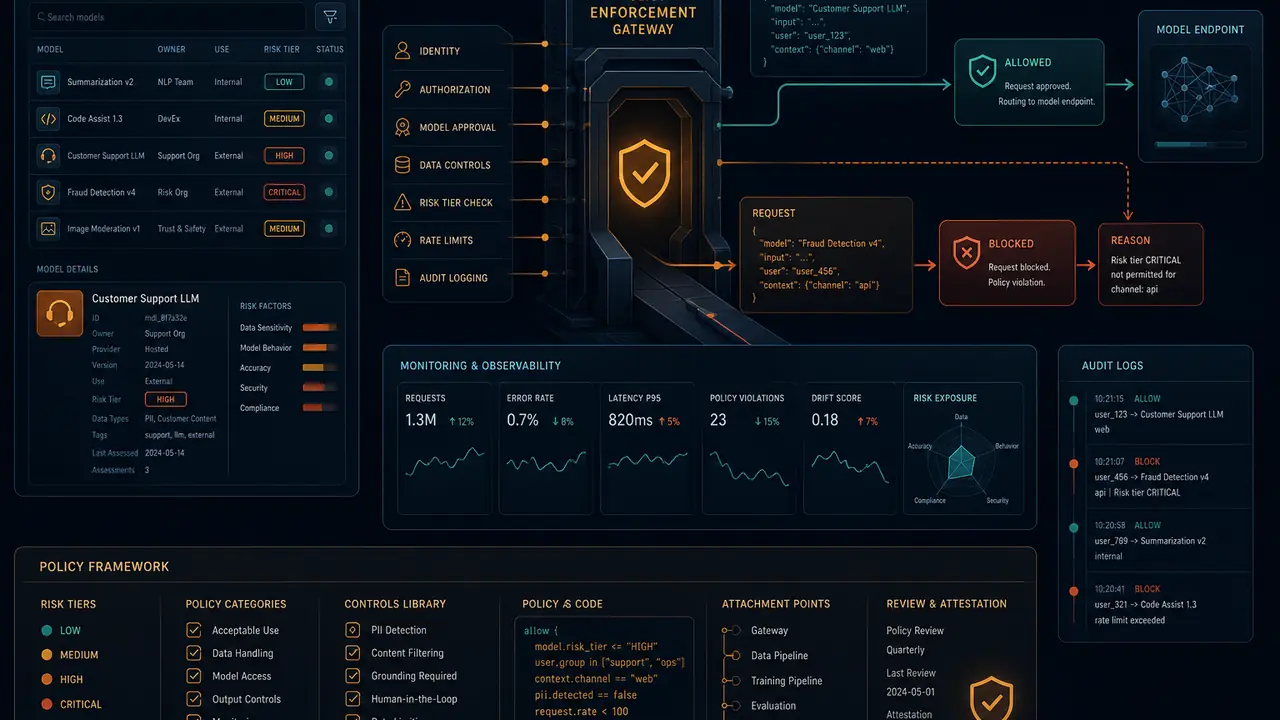
Your employees already paste customer records, contracts, and source code into public chatbots. Shadow AI multiplies that habit across teams, vendors, and browser extensions. When the board, a regulator, or a customer asks how a decision was made and whether you can audit it, a policy PDF is not an answer.
Governance is policies plus technical controls plus monitoring: you know every model in production, what data it touches, who owns it, and how decisions get audited. Treat that as an engineering problem, not a committee deliverable. The yes/no cut is the AI governance checklist.
Shadow AI is already making decisions you cannot reconstruct
You do not need a formal rollout for AI to be in use. Someone in legal pastes a clause into a consumer chatbot. A sales engineer drops a CRM export into a plugin. A contractor wires an API key into a weekend prototype that never gets decommissioned. Each path can move sensitive data off your network and return answers you cannot later explain.
Boards and customers are not asking for a strategy slide. They are asking whether you know which systems influenced a credit decision, a support refund, or a hiring screen—and whether you can show the trail.
If you cannot list the models and tools in use, you cannot assign owners, apply data-class rules, or produce an audit. Assume sanctioned tools and unsanctioned tools coexist. Common AI readiness gaps show up here first: inventory is incomplete, ownership is informal, and evaluation is a one-off demo.
Answer these three questions this week:
- Which models and copilots are actually in use, including browser tools and vendor features that ship AI by default?
- What data classes have already left the building, and through which prompts or connectors?
- Who is on the hook when one of those tools is wrong, leaky, or out of policy?
If those answers live in Slack threads, you do not have a framework. You have folklore.
Policies only work when infrastructure enforces them
A usable policy is short and operational. You name approved tools, you classify data, and you set review thresholds that trigger a human or a higher control.
Approved tools are the models and products you are willing to log, redact, and shut off. Everything else is blocked or treated as an exception with an owner and an expiry date.
Data classes decide what may leave the boundary. Public marketing copy can go to a broader set of models. Customer PII, regulated records, credentials, and unpublished source code cannot. If the class is ambiguous, the default is deny until someone with authority labels it.
Review thresholds keep low-risk work moving. An internal summarizer on already-public docs should not wait for a quarterly committee. A model that ranks people, prices risk, or writes into a system of record should not go live because a team liked the demo.
Enforcement belongs in infrastructure, not in a shared drive. If the only control is “please don’t paste secrets,” you will lose. Put the same rules on the path the traffic already takes: the gateway, the identity provider, the secrets manager, and the CI check that refuses an unsanctioned model endpoint.
One gateway is how you see LLM usage instead of guessing
A secure AI gateway is a single entry point for LLM calls. Applications, internal tools, and approved assistants go through it. You get logging, PII redaction, and cost controls in one place instead of a dozen SDKs with a dozen logging stories.
Logging must be enough to reconstruct who called what, with which data class, and what came back—without storing raw secrets in the log itself. Redaction at the edge stops the most common leak: a well-meaning employee pasting a customer record into a prompt.
Cost controls matter because ungoverned usage is both a security problem and a budget problem. Token spend without an owner is how a prototype becomes a five-figure surprise. Caps, per-team budgets, and kill switches belong next to the authn check, not in a finance spreadsheet after the invoice lands.
The gateway is also where you kill a model or a prompt pattern without hunting through every service. When a vendor model is pulled or a data class is reclassified, you change the gateway policy once. If a team needs a new model, they request it through the same path. You add it to the inventory, assign a risk tier, and attach the evaluations that justify the tier.
Inventory without owners is a spreadsheet that goes stale
A living model inventory is the record you show when someone asks what is in production. For each model or AI-backed feature, you keep:
- An owner who can answer for incidents and changes
- The data it touches, by class, including embeddings and logs
- A risk tier that drives how heavy the controls are
- Evaluation results, with dates, not a screenshot from the pilot
Shadow systems belong in the same inventory once you find them. You either sanction the tool under the gateway, replace it, or block it.
Risk-tiering keeps controls proportionate. Low-risk internal tools get lighter review and faster change. High-risk systems—anything that affects people, money, safety, or regulated data—get stricter evaluation, tighter data rules, and a slower promotion path.
Map controls to the NIST AI Risk Management Framework so auditor language matches engineering work. Govern, Map, Measure, Manage is a loop: you know the context, you measure the system, you put controls on it, and you keep doing that after launch.
What good looks like is directional, not a contract. You want inventory coverage you can defend, leak paths you can close when you find them, and evaluations that run on a calendar. You do not promise zero leaks or a perfect catalog as an SLA.
Evaluation and monitoring catch drift before a customer does
Accuracy drift is not academic. A classifier that was fine on last quarter’s tickets will quietly fail when the product catalog or the fraud pattern changes.
Prompt injection exposure is a production concern. Any system that reads email, tickets, documents, or web pages can be steered by content it did not treat as untrusted. You test for that the same way you test for XSS: with cases, not with optimism.
Policy violations are the third feed. The gateway should tell you when someone tried to send a forbidden data class, hit an unapproved model, or exceeded a budget.
Stand up a small loop:
- Define the evaluations that match the risk tier: accuracy, safety, injection, and data handling.
- Run them on a cadence, and again after material prompt, model, or data changes.
- Page the owner when drift or violations cross the threshold you already wrote down.
- Record the outcome on the inventory row so the next audit is a query, not a scavenger hunt.
If you cannot name the last time a production model was re-evaluated, it is not governed. It is deployed.
Discover, tier, implement, then run it like production
The method is four steps, in order.
Discover both sanctioned and shadow use. Interview teams, inspect SSO and SaaS admin consoles, read DNS and proxy logs, and ask finance which AI line items appeared.
Risk-tier what you find so controls stay proportionate. Fast-track the low-risk tools that already have an owner and a clean data class. Put people-impacting and regulated-data systems at the top of the queue.
Implement guardrails in their environment. Gateway, identity, redaction, logging, and deployment checks have to live where the traffic already is. A reference architecture in a slide does not redact a prompt. A control in the path does.
Operationalize the rest: a review cadence, incident playbooks, and training that names the approved tools and the data classes. Playbooks should say who gets called when a model is wrong in production, when a leak is suspected, and when a vendor changes terms. Training should be short: the three things they must not paste, not a 40-page standard.
Do the work in that sequence even if a stakeholder wants a framework document first. The document is the output of discovery and tiering, not the substitute for it.
The next step is not another workshop. Put these controls on the path your LLM traffic already takes. See how Mufasa Labs implements this as engineering—secure gateway, living inventory, risk-tiering, and NIST AI RMF-mapped controls—on the AI governance page.
