
AI proof of concept vs production AI
A proof of concept answers a planted question. Production AI survives real tickets, real permissions, and a number you can defend.
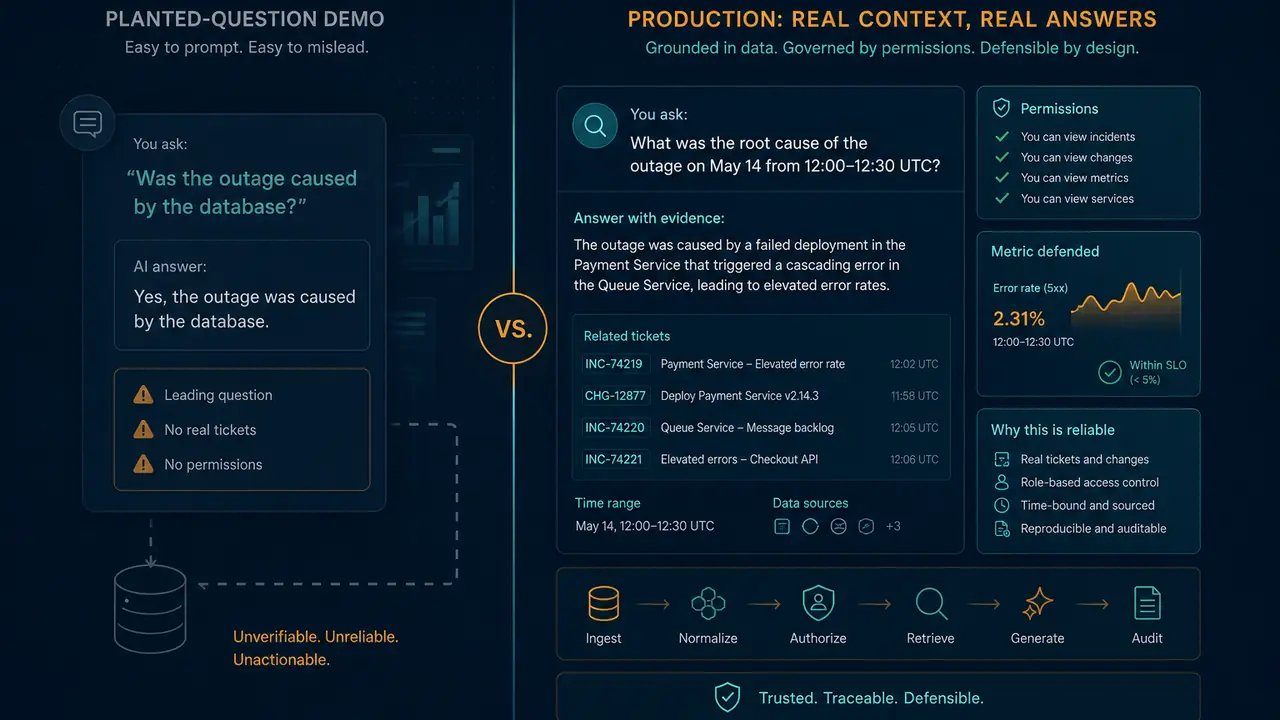
A proof of concept is a planted question on clean files. Production AI is a system that survives messy tickets, real permissions, and a person who has to stand behind the output. Confusing the two is how a good room becomes a year of "almost."
We treat the first live workflow as the product of enterprise AI consulting, not a sequel you buy after you like the slides. The usual ways a POC stays a POC are in common enterprise AI implementation failures.
What a POC is for
A POC answers one technical question. Can we retrieve from this source. Can the model extract these fields. Can we stay inside this latency. It should be cheap, time-boxed, and allowed to fail.
It is not a purchase order. It is not a go-live. It is not evidence that users will change how they work on Tuesday.
If your POC used sample data, a shared admin login, or a scripted demo script, you learned about the model. You did not learn about the business.
What production requires
Production means the system lives in your cloud and your repos. Retrieval respects the same permissions a person already has. Evaluation can be rerun when the model or the corpus changes. Someone owns the output when it is wrong. There is a baseline and a after number.
If you vanished, it should still run. If the only copy lives in a vendor chat, you rented a conversation.
Logging is not optional. You need to see what was retrieved and what was sent. An auditor will ask. So will the first angry customer.
Seven tells you are still in POC
1. The happy path is the only path. Missing fields and stale policies were out of scope.
2. Access is a service account that can see everything. That will not survive security, and it should not.
3. Success is applause. There is no cycle time or error rate written down from before.
4. The builders are the only users. The desk has not touched it.
5. Prompts live in a notebook. There is no version, no eval set, no owner.
6. Go-live is a meeting. There is no runbook, no fallback, no who-gets-paged.
7. The next slide is a platform. You are using the POC to justify a lake instead of finishing one workflow.
How to graduate a POC without lying
Write the production checklist before you start the POC, not after it looks good. Permissions, eval, owner, baseline, repo, fallback. If you cannot afford that list, you cannot afford production. Stop at the experiment and say so.
Time-box the POC. Two weeks is a question. Two months is a hiding place.
Put the real user in the last three days of the POC, on real tickets, with a human in the loop. If they will not use it there, they will not use it after the banner goes up.
If the POC fails, bury it in writing. That is cheaper than a quiet zombie.
Where consulting should sit
A useful firm will tell you whether you need a POC, a production pilot, or neither. Sometimes the first spend is readiness: data and access, not another sandbox. Sometimes you already know the workflow and should skip the POC and scope a fixed build.
If they call every demo production-ready, they are selling hope. If they refuse to ship anything in the first engagement, they are selling chapters.
The sequence we use is assess, prioritize, prove on real work, then scale. Prove means production-shaped, not conference-shaped.
How that engagement is scoped is on enterprise AI consulting.
