
Common enterprise AI implementation failures
Enterprise AI fails in the same few ways: no owner, no baseline, a demo treated as production, and a platform bought to skip the first workflow.
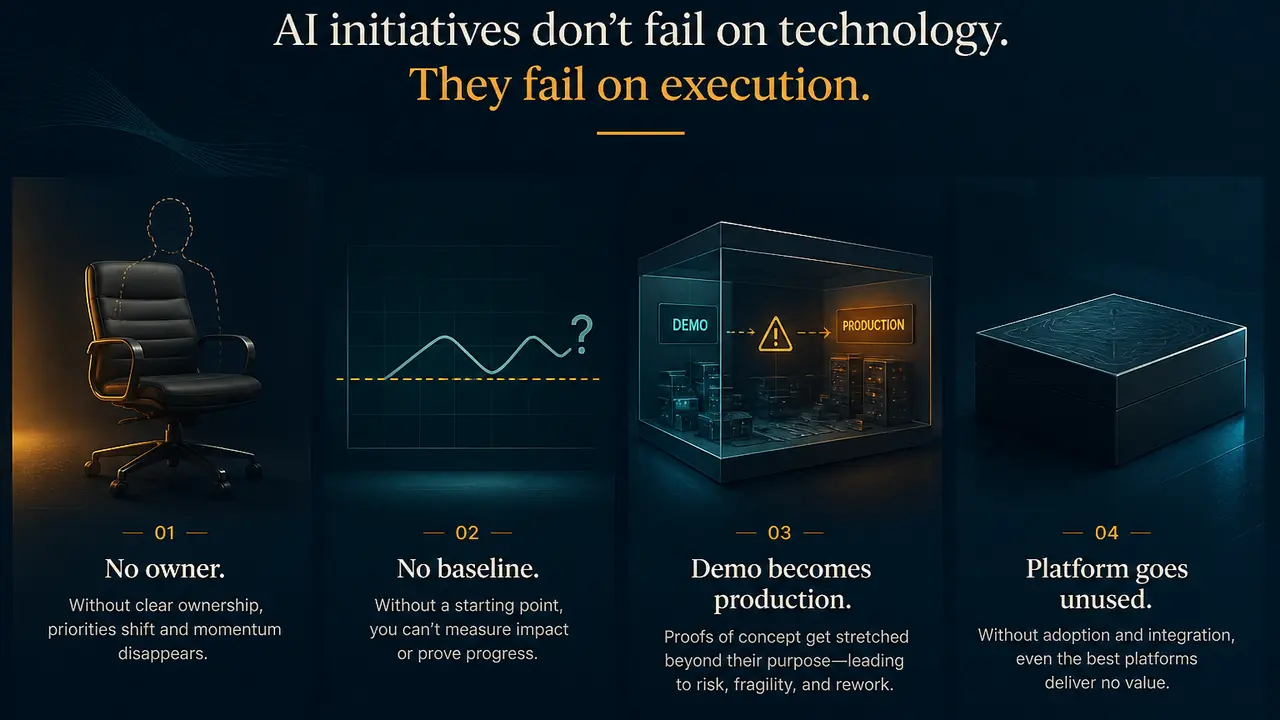
Enterprise AI implementations fail in a short list of ways. The model is rarely the cause. The cause is a missing owner, a missing number, or a platform that arrived before the first workflow.
If you want the pattern we use to avoid this, it is on enterprise AI consulting: score readiness, pick one path, ship a pilot with a metric, then scale what worked. The demo-versus-live split is in AI proof of concept vs production AI.
1. No named owner for the live output
The steering committee loved the demo. The desk that would use the output was not in the room. When the model is wrong on a Tuesday, nobody is paid to stand behind it. The spreadsheet wins.
Fix: name the user of the output before you name the model. Put a human in the loop on purpose for the first month.
2. No baseline, so nobody can defend the spend
Success was "users liked it." Finance asks what changed. There is no cycle time, no error rate, no hours. The program waits for the next budget cycle and dies there.
Fix: write the before number in week one. If you cannot get it, you do not have a project yet.
3. The demo was treated as production
A planted question on sample files became the go-live. Real tickets have missing fields, stale policies, and permissions the demo never saw. The first week produces fluent wrong answers. Trust does not come back.
Fix: production means the repo, the cloud account, evaluation you can rerun, and retrieval that respects the same permissions a person already has. A better prompt is not that list.
4. A platform was bought to skip the first workflow
A lake, a copilot suite, and a council were funded because they look like maturity. The first desk job is still undefined. The bill is now the strategy.
Fix: pick one painful step that already lives in your systems. Score readiness on data, automation, adoption, and governance. The lowest score is the constraint. Do not buy around it.
5. Shadow AI ran faster than the paved road
Official tools needed a six-month review. People pasted customer data into public chats the same week. Security found out from a screenshot.
Fix: a short allow-and-deny list this week, then a gateway later. If the official path is slower than the dirt path, everyone uses the dirt path.
6. Consultants left a roadmap with no one to run it
The deck has owners in name only. The named people have day jobs. Six months later you rehire someone to explain the same slides.
Fix: either keep an owner in the monthly rhythm (a fractional CAIO if you do not have the seat) or make the first pilot small enough the existing CIO can run it. Do not pay for a plan you will not staff.
7. Build-versus-buy was a vibe
Someone preferred a logo. There was no total-cost math, and the advisor earned on the license. You now own a tool that does not sit on the workflow you actually run.
Fix: put build hours, buy licenses, and do-nothing on one page. Independent advice means no kickbacks. Delivery, if it happens, is a separate capped scope.
8. Governance existed only as a PDF
The policy was forty pages. Nothing fired on the request path. Auditors asked for an inventory of models and you opened a spreadsheet from last spring.
Fix: inventory what is already running, risk-tier it, log what the first workflow retrieves and sends. Paper after the control, not instead of it.
What to do this month
Pick the failure you already have. Write it down. Kill one vendor or one fake use case. Baseline one workflow. If you need a firm to force that sequence, hire one that ships the pilot in the same engagement, not a sequel.
How we run that sequence is on enterprise AI consulting.
