
How to choose an AI consulting company
Choose an AI consulting firm by who ships the first pilot, who owns the math on build vs buy, and who will tell you not to start.
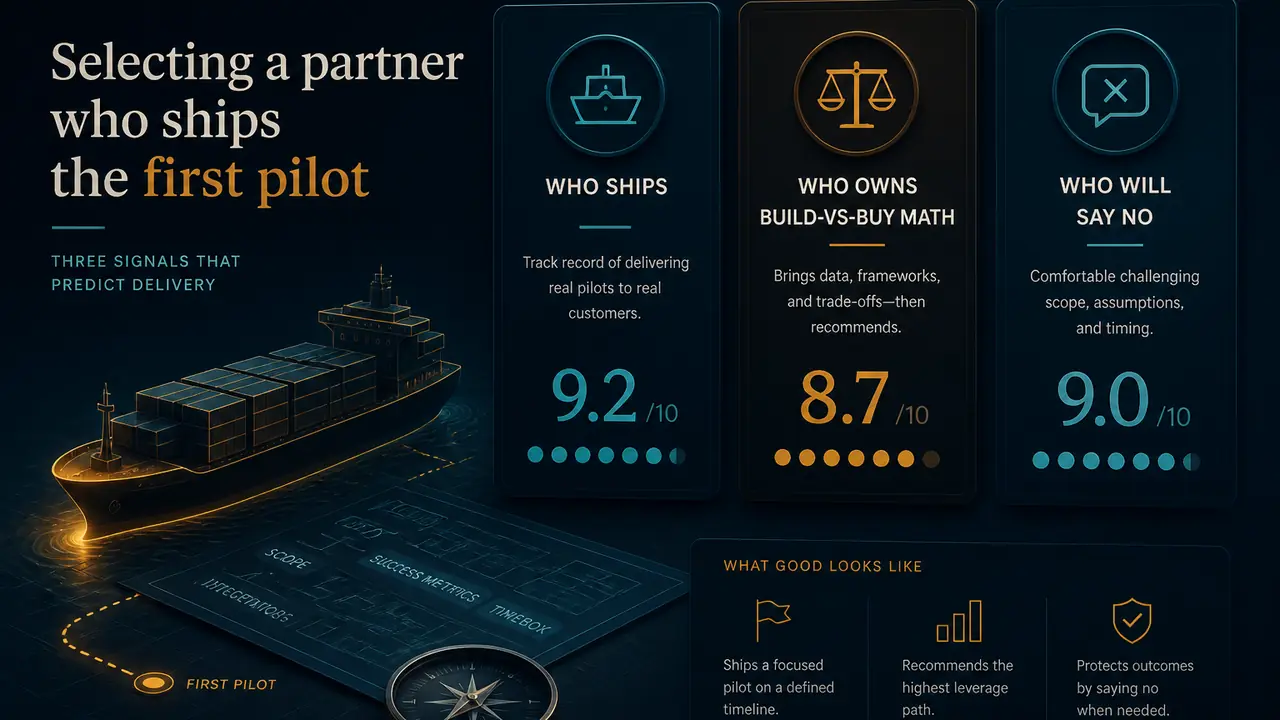
Most AI consulting pitches sound the same until you ask who ships the first pilot and who gets paid if you buy a platform. The wrong firm leaves you with a deck, a vendor shortlist they resell, and a pilot that never meets a live ticket.
Here is how to pick. The bar we hold ourselves to is on enterprise AI consulting: practicing engineers, no license kickbacks, one working pilot as part of the engagement.
1. Ask who does the work after the workshop
If the people in the sales call are not the people who will sit in your systems, you are buying a relay. Recommendations that cannot survive implementation are stationery.
Ask who will write the readiness report, who will sit with the desk that runs the messy process, and who will be on the hook when the pilot is wrong. If the answer is "our delivery partner," you are the integration layer.
2. Demand a first pilot in the same statement of work
A roadmap with no proof is a hypothesis. A serious firm sequences two to three weeks of assessment and then ships the top use case on real work, with the success metric written down first.
If they want a second contract before anyone touches production data, they are selling chapters. If they want to "enable your team to self-serve the pilot," they are leaving. The usual failure after they leave is in common enterprise AI implementation failures.
3. Get build-versus-buy with the math, and no kickbacks
Ask how they make money if you buy software. If they resell licenses or take a referral, their independence is a slide.
Ask for total cost on the first workflow: build hours, buy licenses, and do-nothing. If they will not put numbers on a page you can check, they are steering you toward whatever is in their kit.
4. Make them name the first workflow, not the vision
"Transform the enterprise" is not a use case. Intake, review, a weekly report, a search that cites the live policy: those are use cases. If they cannot pick one after a short look at your stack, they have not looked.
A readiness score across data, automation, adoption, and governance is a faster filter than a 40-page RFP. The lowest dimension is the constraint. A firm that ignores the floor and starts with a platform is selling around the gap.
5. Listen for "not yet"
The useful consultant will tell you the first spend is data access, a permission model, or a kill list for shadow tools. An honest no is worth more than a pilot that was always going to stall.
If every answer is yes and the only variable is how big the phase-two is, you are not being advised. You are being expanded.
6. Price the empty seat, not the brand
Big-firm retainers buy process and a junior bench. Mid-market teams usually need senior hours and a date measured in weeks. Ask who is billable in week two. Ask what happens if the named lead rotates off.
A 30-minute scoping call should end with a range, a timeline, and a recommendation you can take to the board, including wait. If they need a paid discovery to tell you whether they can help, that discovery is the product.
A short scorecard
Write five lines before you sign. Who ships the pilot. Who owns build-versus-buy with no kickback. What the first workflow is. What they will refuse to do. What you can cancel.
If you cannot fill those lines from their proposal, do not hire them to fill your roadmap.
More on how we run the engagement is on enterprise AI consulting.
