AI readiness for manufacturing: what to check before a plant pilot
AI readiness for manufacturing means your machine data, OT and IT networks, and plant teams can carry a model from historical data to decisions on the floor. Use this checklist to test one line before you fund a predictive maintenance or vision inspection pilot.
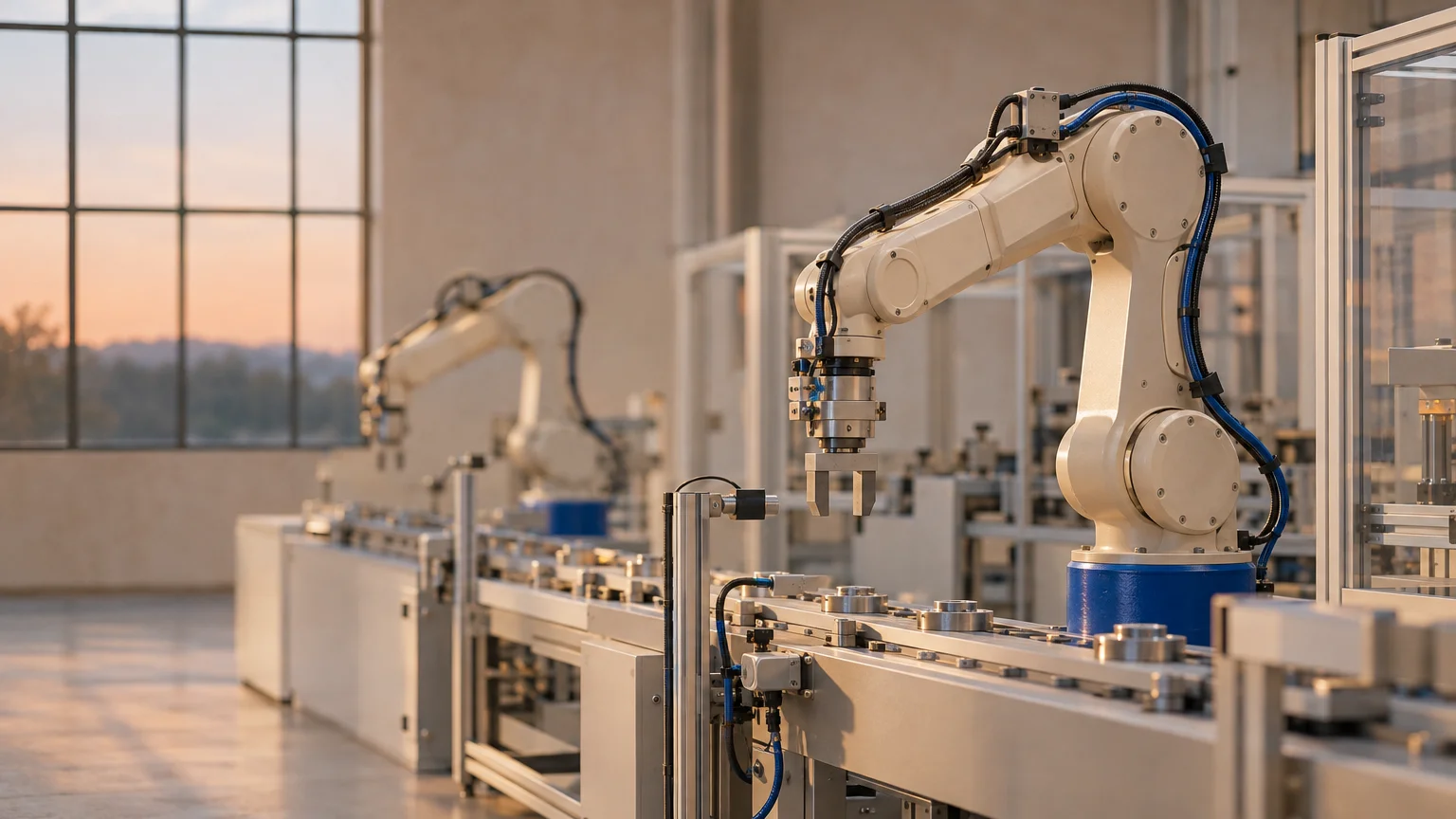
Most manufacturers asking about AI readiness already have a pilot in mind: predictive maintenance on a critical line, vision inspection at end of line, or a copilot for maintenance technicians. The question is whether the plant can actually support it. AI readiness for manufacturing comes down to whether your machine data, plant networks, and people can carry a model from a demo on historical data to a decision someone on the floor trusts at 2 a.m.
This guide walks through what to check before you fund a plant pilot, where manufacturers usually fall short, and how to sequence the work so the first project does not stall.
Your machine data is probably less usable than your dashboards suggest
Plants generate a lot of data, and most of it was never collected with modeling in mind. A historian that stores sensor values at one-minute averages looks complete on a trend chart, but it can hide the short spikes and vibration signatures a failure prediction model needs. Tag names drift between lines, units change after a retrofit, and timestamps from the PLC, the MES, and the CMMS rarely agree.
Before you pick a use case, check four things on the specific asset or line you care about:
- Resolution: Is the data sampled and retained at a rate that captures the behavior you want to predict, or has it been compressed or averaged away?
- Labels: Do you have a reliable record of the events you want to predict, such as failures, scrap, or quality escapes, with accurate times? Work orders that say "fixed it" are not labels.
- Context: Can you join sensor data to product, recipe, shift, and maintenance history without a week of spreadsheet work?
- History: Is there enough history to include the conditions that matter, such as seasonal changes, different products, and at least several instances of the failure mode?
If labels are the gap, that is the most common and most expensive one to discover late. A predictive maintenance model with no trustworthy failure history becomes an anomaly detector, which is useful but a different project with a different payback. We cover the broader pattern in common AI readiness gaps.
OT and IT have to agree on how data leaves the plant floor
In most plants, the operational technology network is segmented from the corporate network on purpose. That segmentation protects production, and an AI project should not weaken it. But it also means there is often no sanctioned path for line data to reach the cloud or a data platform where models are trained.
Readiness here is less about technology and more about agreement. Ask who owns the path from the control layer to the data platform, whether data flows one way out of the OT network, and who approves changes. If the answer involves an engineer's laptop and a USB drive, your pilot will work once and then never again.
The tradeoff to name early is edge versus cloud. Inference at the edge keeps latency low and keeps working when the plant's internet link goes down, but it means managing models on hardware your controls team maintains. Cloud inference is easier to update and monitor, but it adds a dependency that a production line may not tolerate. Many manufacturers end up training centrally and running inference near the line, which needs a deployment process both teams sign off on.
Pick a use case where the plant can act on the prediction
A model that predicts a bearing failure three days out only creates value if someone schedules the repair, has the part, and can take the line down. Many manufacturing AI pilots are technically accurate and operationally ignored because no workflow changed.
For each candidate use case, write down the decision it supports, who makes it, and what they do differently. Then check the constraints:
- Can maintenance or quality act within the prediction window, given staffing and spare parts?
- Is there a planned downtime window, or does every intervention cost unplanned stoppage?
- What happens when the model is wrong, both a false alarm and a missed event? On a high-speed line, a false stop can cost more than the failure it was meant to prevent.
- Who on the floor will see the output, and in which system they already use?
Use cases with a clear owner and a cheap response, such as flagging a quality drift for an operator to inspect, tend to reach production faster than ones that require a schedule change across departments. Our framework for prioritizing AI use cases goes deeper on scoring value against feasibility.
Vision inspection has its own readiness checklist
Camera-based inspection is one of the most practical AI uses in manufacturing, and it fails for reasons that have little to do with the model. Lighting changes with time of day and maintenance, lenses get dirty, part presentation varies, and the defects you care most about are often the rarest in your image set.
Before committing to vision inspection, confirm that you can control lighting and part position at the station, that you can collect and label enough examples of real defects rather than only good parts, and that quality engineers agree on what counts as a defect. If two inspectors disagree on the same part, the model will learn the disagreement. Plan for how the station behaves when the camera or model is unavailable, so the line does not stop or ship uninspected parts by default.
The people side is where plant pilots quietly stall
Readiness is not only data and networks. Manufacturers often have strong controls engineers and process engineers but no one whose job is to keep a model healthy after launch. Models drift when suppliers change, recipes are tuned, or equipment is replaced, and someone needs to notice.
Check whether you have:
- A plant-side owner, usually in operations or reliability, who is accountable for the outcome, not only the IT project.
- Someone who can monitor model performance and retrain or roll back, whether that is an internal data team, a vendor under contract, or a partner.
- Operator buy-in. If the people on the line see the system as surveillance or as a threat to their judgment, they will route around it.
- A plan for frontline feedback, so operators can mark false alarms and that feedback improves the model.
If nobody owns the model after the pilot, the pilot is the whole project. That is the gap described in AI proof of concept vs production AI.
Score readiness per line, not per company
A single enterprise readiness score hides the fact that one plant may have a modern historian and a cooperative controls team while another runs equipment older than its operators. Assess readiness for the specific line or asset family you plan to start with, using the same dimensions each time: data quality and labels, OT and IT connectivity, decision workflow, operating ownership, and security and governance.
This gives you a defensible way to choose the first site, and a list of fixes that are cheap to make before the pilot instead of expensive to discover during it. For a general scoring approach you can adapt, see how to measure AI readiness.
Start with a scoped readiness review of one line
Pick the line or asset where you most want an AI win, and spend two to three weeks answering the questions above with the people who run it: the plant manager, a reliability or quality engineer, someone from controls, and someone from IT security. The output should be a short list of go or no-go findings, the fixes required before a pilot, and a realistic first use case with a named owner.
If you want an outside view, Mufasa Labs runs AI readiness assessments for manufacturers that cover data, plant connectivity, use case fit, and operating ownership, and end with a pilot plan your plant team agrees to. Talk to us about an AI readiness assessment.